



Copernical Team
A navigation odyssey
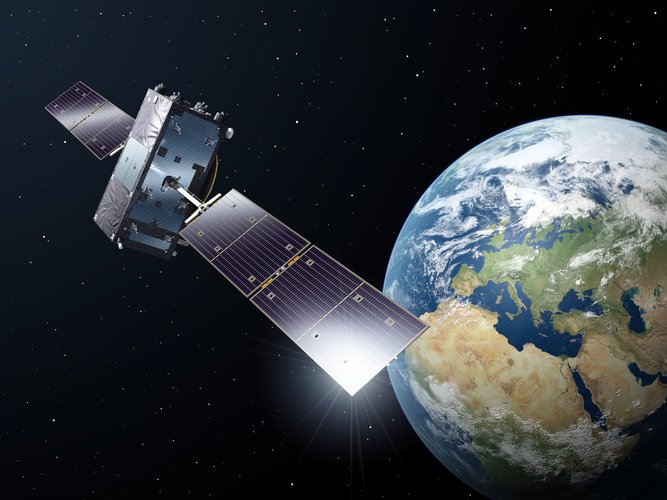
Homer’s The Odyssey chronicles Odysseus’s journey home to Ithaca after the Trojan War. A distance of approximately 530 km as the crow flies, yet it takes Odysseus ten years and countless adventures to arrive—without his crew or his boat. What could Odysseus’s journey have looked like if he had modern-day satellite navigation systems, such as Galileo, at his disposal?
Sophie Adenot's third spacewalk (U.S. Spacewalk 99)
 Video:
00:00:50
Video:
00:00:50
ESA astronaut Sophie Adenot will take part in her third spacewalk during U.S. Spacewalk 99 on Tuesday 1 September. NASA live coverage will begin at 13:00 CEST, with the spacewalk expected to start at approximately 14:30 CEST and last around six and a half hours.
Together with NASA astronaut Jessica Meir, she will replace a retroreflector on the International Space Station’s Harmony module, supporting spacecraft navigation during rendezvous and docking operations. The astronauts will also carry out several maintenance tasks, including installing data-relay system jumper cables, preparing the Alpha Magnetic Spectrometer’s radiator for future maintenance and replacing a
Observing Samba and Tango’s reentries

The final two of ESA's pioneering Cluster spacecraft, Samba and Tango, will end their journeys as they burn up in our atmosphere on 31 August and 1 September respectively. Their targeted reentries mark the end of a mission that has transformed our understanding of Earth's magnetic environment. The final moments also offer a rare scientific opportunity for reentry observations from a plane.
Ariane 6 launch with MTG-I2 – highlights
 Video:
00:04:28
Video:
00:04:28
The Meteosat Third Generation-Imager2 (MTG-I2) satellite, has been launched on board an Ariane 6 launcher from Europe’s Spaceport in French Guiana. Liftoff was on 27 August 2026 at 22:11 CEST (17:10 local time).
MTG-I2 is part of the MTG constellation for Eumetsat – two are already in orbit – and it will produce images for weather forecasting in Europe in unprecedented detail. This mission provides completely new data products and capabilities for European weather services, especially suited to nowcasting of severe weather events.
The MTG-Imager satellites carry two instruments, a Lightning Imager and a Flexible
Week in images: 24-28 August 2026

Week in images: 24-28 August 2026
Discover our week through the lens
Media invitation: FLEX and Copernicus Sentinel-3C online media briefings
Press Release N° 44–2026
Media representatives are invited to join online media briefings in several languages ahead of the launch of the FLEX and Copernicus Sentinel-3C satellites on a Vega-C rocket (flight VV30).
MTG-I2 completes Europe’s latest weather trio

The second Meteosat Third Generation Imager satellite (MTG-I2) has been launched on board Ariane 6, flight VA270, from Europe’s Spaceport in French Guiana. It will complete the first family of MTG satellites, delivering data for weather forecasting over Europe and northern Africa with unprecedented quality, quantity and frequency.
First contracts kick off European Launcher Challenge

Watch live: BepiColombo begins its arrival at Mercury

After eight years, the ESA/JAXA BepiColombo mission is about to enter its Mercury Arrival Phase. On 3 September 2026, ESA’s Mercury Transfer Module (MTM) will separate from BepiColombo’s two science orbiters – the first major step in one of the most operationally challenging planetary arrival sequences ever attempted by ESA.
The European Space Agency (ESA) will livestream the critical milestone from 13:45 CEST. Tune in and witness the first step of one of the most complex phases of the mission, live from ESA mission control.
Join ESA's livestream on YouTube here!
MTG-I2 ready for launch on Ariane 6

The Meteosat Third Generation Imager2 satellite (MTG-I2) has been encapsulated inside the Ariane 6 fairing and is in place on its launch pad. It is scheduled to lift off on Thursday evening, 27 August, from Europe’s Spaceport in French Guiana.