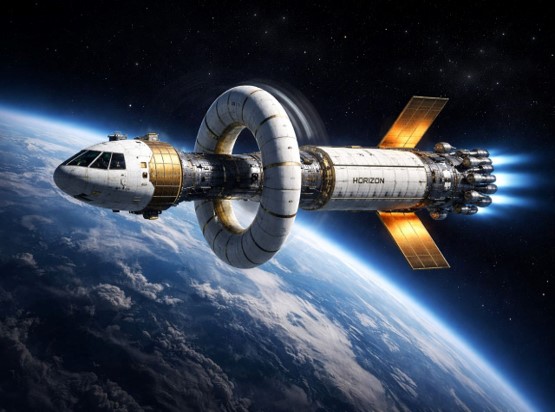

The Horizon project is a fully reusable manned interplanetary spacecraft designed for regular missions to the Moon, Lagrange points, and Mars. Powered by a 1 MW nuclear-electric propulsion system and featuring a deployable tether-based artificial gravity module, it offers cost-effective and sustainable deep-space logistics.
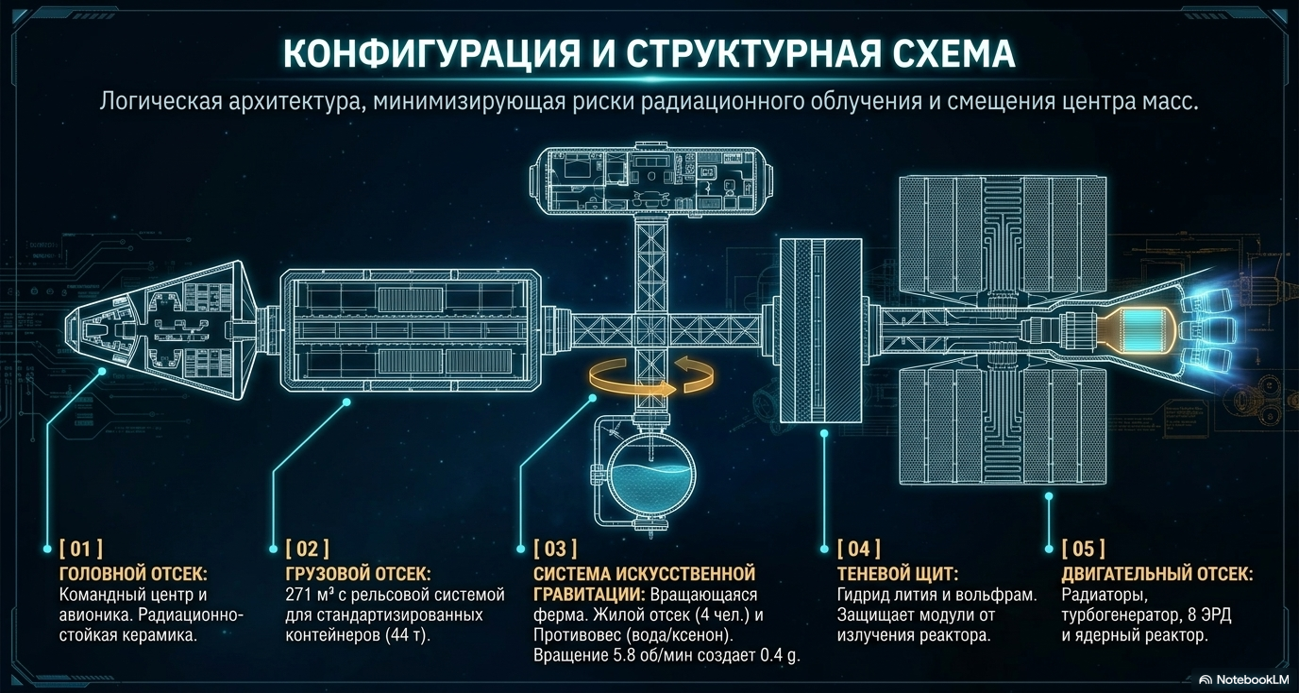
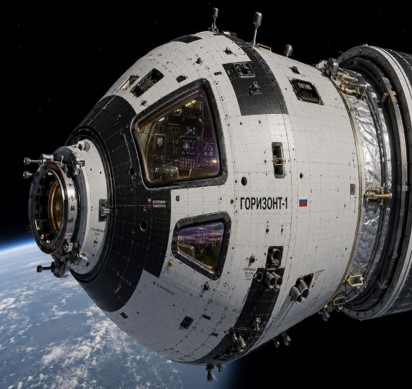
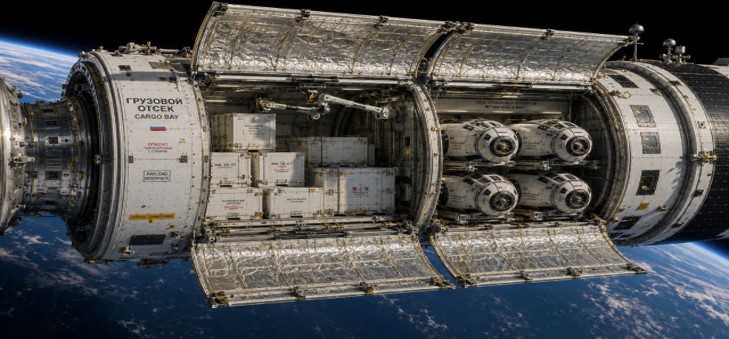
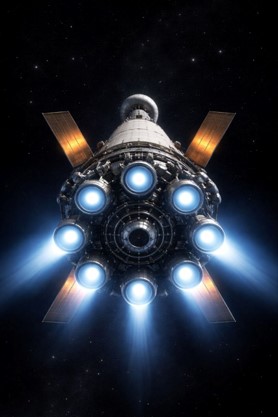
The Horizon spacecraft represents a comprehensive engineering solution for the next generation of interplanetary exploration. Its modular architecture includes a habitable head section, a cargo compartment with a robotic manipulator, a deployable tether-based artificial gravity system, and a propulsion bay housing a 1 MW nuclear reactor driving a cluster of eight Hall-effect thrusters (total thrust 48 N, specific impulse 4000 s).
Key mission capabilities:
-
Lunar missions: delivery of crew (6 persons) and cargo to the surface via a two-stage landing module (14.7 t launch mass), with a transit time of ~74 days.
-
Lagrange point operations: station-keeping and servicing at Earth-Moon L1/L2, transit ~33 days.
-
Mars expeditions: low-thrust transfer in 116–164 days (depending on initial mass), with a dedicated 32.1 t Martian landing module (LOX/CH4, s) for surface operations up to 500 days.
Innovations:
-
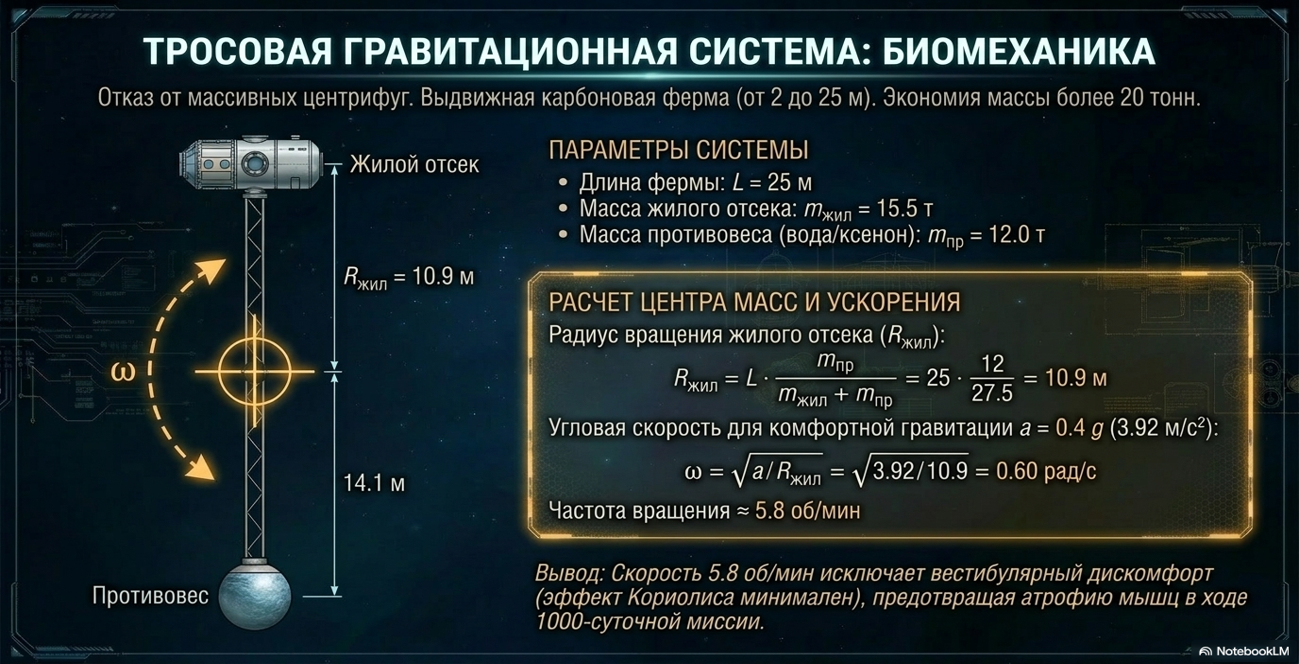
Artificial gravity via a 25 m carbon-fiber tether and a counterweight (water or propellant tanks), producing at only 5.8 rpm – well below the vestibular comfort limit, and saving over 20 tonnes compared to a rigid centrifuge.
-
Closed-loop life support with 98% water recycling and full oxygen regeneration, supporting 1000 days of autonomy.
-
Thermal control with deployable liquid-metal radiators (area ~245 m²) rejecting 3 MW of waste heat.
-
Radiation shielding – a shadow shield (lithium hydride + tungsten) plus boron-loaded polyethylene against galactic cosmic rays.
The project incorporates technologies from Roscosmos' nuclear tug "Zeus" (TEM), including a megawatt-class reactor, ion thrusters, and autonomous control systems. The total launch mass (without landing modules) is ~190 t, with a cargo capacity of up to 44 t. Orbital refueling is foreseen to extend mission range and reusability.
Horizon is designed to become the backbone of a sustainable interplanetary transport infrastructure, enabling routine human presence beyond Earth orbit. The author welcomes collaboration, feedback, and further development of this concept.