


Planet beefs up AgData with launch of Field Boundary detection technology
Tuesday, 12 March 2024 21:19 Planet Labs PBC (NYSE: PL) this week unveiled its latest innovation, Field Boundaries, as part of its advanced Planetary Variables data feed series, and marking a significant advancement in agricultural data and insights.
Field Boundaries aims to revolutionize the infrastructure for agricultural solutions by offering unparalleled precision in regional crop monitoring and yield predictions
Planet Labs PBC (NYSE: PL) this week unveiled its latest innovation, Field Boundaries, as part of its advanced Planetary Variables data feed series, and marking a significant advancement in agricultural data and insights.
Field Boundaries aims to revolutionize the infrastructure for agricultural solutions by offering unparalleled precision in regional crop monitoring and yield predictions Third satellite-carrying transatlantic Beluga flight lands in Florida
Tuesday, 12 March 2024 19:27

Zero-boil-off tank experiments to enable long-duration space exploration
Tuesday, 12 March 2024 19:18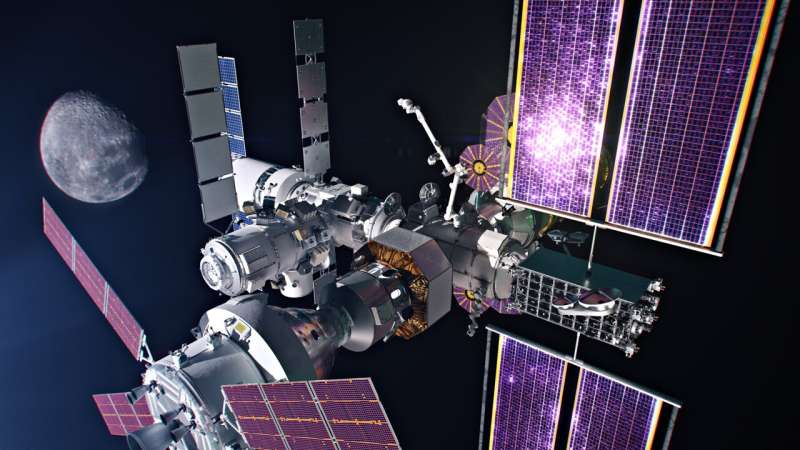
Do we have enough fuel to get to our destination? This is probably one of the first questions that comes to mind whenever your family gets ready to embark on a road trip. If the trip is long, you will need to visit gas stations along your route to refuel during your travel.
NASA is grappling with similar issues as it gets ready to embark on a sustainable mission back to the moon and plans future missions to Mars. But while your car's fuel is gasoline, which can be safely and indefinitely stored as a liquid in the car's gas tank, spacecraft fuels are volatile cryogenic liquid propellants that must be maintained at extremely low temperatures and guarded from environmental heat leaks into the spacecraft's propellant tank.
And while there is already an established network of commercial gas stations in place to make refueling your car a cinch, there are no cryogenic refueling stations or depots at the moon or on the way to Mars.
Operational modal analysis of the Artemis I dynamic rollout test
Tuesday, 12 March 2024 17:27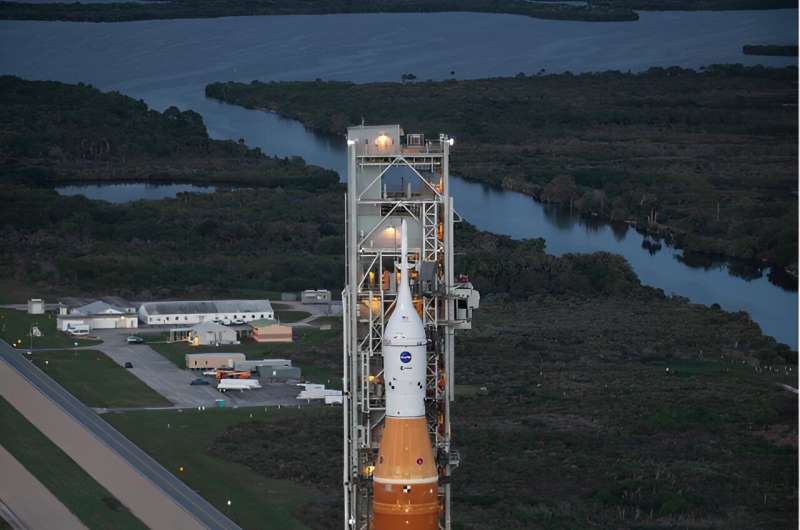
Operational modal analysis (OMA) techniques have been used to identify the modal characteristics of the Artemis I launch vehicle during the Dynamic Rollout Test (DRT) and Wet Dress Rehearsal (WDR) configuration prior to launch. Forces induced during rollout and on the launch pad are not directly measurable, thus necessitating a unique approach.
NASA is developing the SLS to support lunar and deep space exploration. SLS is integrated inside the Vehicle Assembly Building (VAB) on the mobile launcher (ML), which supports the integrated SLS launch vehicle during transport to the pad through lift-off. The ML also provides the fuel, power, and data umbilicals running to the SLS and Orion Multi-Purpose Crew Vehicle (MPCV), as well as crew access to the MPCV crew module.
The ML weighs ~10.6 million pounds and is over 380 feet tall. In the spring of 2022, the SLS was transported on the ML from the VAB to Launch Pad 39B (Figure 1) using the NASA crawler transporter (CT) to make this 4.2 mile trek, which takes ~8 hours.
The next space flight accident: How do we prevent it?
Tuesday, 12 March 2024 17:26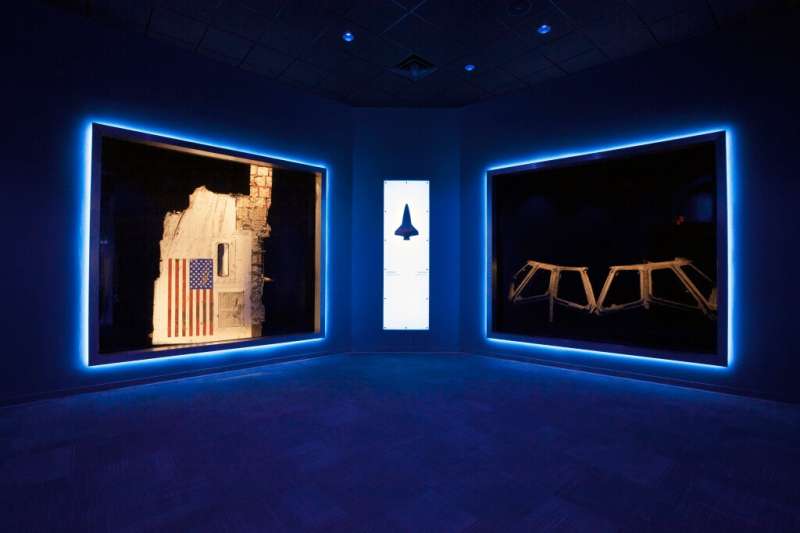
I recently watched NESC Deputy Director Mike Kirsch stand before a roomful of engineers at the Langley Research Center and tell them that with every passing day, NASA breaks a record: the longest stretch without a major accident in the nation's human spaceflight program since the Space Shuttle Columbia disintegrated during reentry on February 1, 2003. NASA's challenge, he told them, was to make sure the record keeps being broken.
Mike's sobering message set the perfect tone for my presentation of "Principles of Success in Spaceflight," the class I created with Victoria Kohl on the human behavior elements of success and failure in spaceflight projects.
Japan creates multibillion-dollar space strategic fund to boost space industry
Tuesday, 12 March 2024 16:50


The return of Andreas Mogensen | Huginn Mission
Tuesday, 12 March 2024 13:16 Video:
00:03:01
Video:
00:03:01
After more than 6 months on the International Space Station, ESA astronaut Andreas Mogensen returned to Earth, marking the end of his Huginn mission. It was his second mission to the Space Station and his first long-duration, where he was the pilot of Crew-7, which consisted of Jasmin Moghbeli (NASA), Satoshi Furukawa (JAXA), and Konstantin Borisov (Roscosmos).


During the 2024 solar eclipse, Texans will aid a national research effort to study the sun
Tuesday, 12 March 2024 10:30
On a sunny February day at Dallas' Frontiers of Flight Museum, a cluster of students lifted telescope equipment out of a bulky briefcase. A sticker on the case read: "stand back—we're going to science!"
Using a compass and a spool of green thread for alignment, the students fastened their telescope on top of a tripod with the sun framed in view.
On April 8, they'll set up the telescope again, this time on a riverbank 140 miles south of Dallas. They'll be capturing images of the total solar eclipse, when the moon will appear to completely block the sun, causing a brief period of darkness called totality.
Their work will contribute to a national research project called the Citizen Continental-America Telescopic Eclipse 2024 experiment, or CATE 2024. Led by the Southwest Research Institute the project will task crews of volunteers with handling 35 telescopes along the U.S. path of totality, with four in North Texas.
Citizen science efforts like this one will take place across the country during the eclipse, and are designed to bring scientific research out of the ivory tower.
Four astronauts from four countries return to Earth after six months in orbit
Tuesday, 12 March 2024 09:08 astronaut Andreas Mohgensen, NASA astronaut Jasmin Moghbeli, and JAXA (Japan Aerospace Exploration Agency) astronaut Satoshi Furukawa. The quartet splashed down off the coast of Florida on Tuesday, March 12, 2024, completing a six-and-a-half-month space research mission. Credit: NASA via AP")
Earth observation camera maker raises $15 million for European expansion
Tuesday, 12 March 2024 03:01


