

Kitesurfing the white wilderness for science
Thursday, 16 December 2021 09:40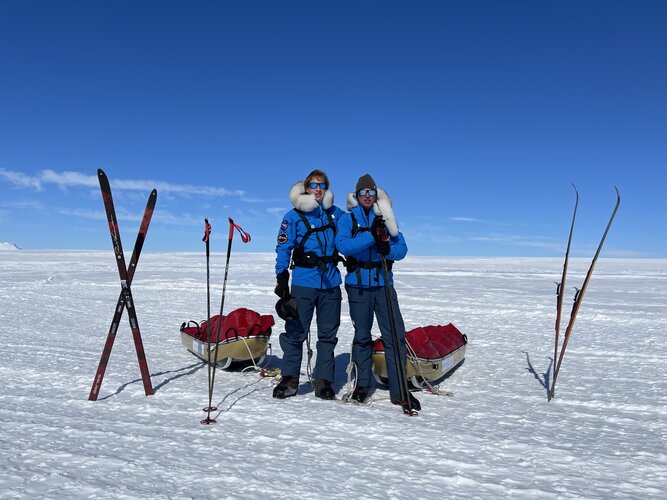
In an astonishing feat of endurance, explorers Justin Packshaw and Jamie Facer Childs are a quarter of the way through a 3600-km kitesurf trek that takes them across the desolate heart of Antarctica. They are not pushing their physical and mental limits to the brink, facing howling gales and temperatures of –55°C just for the sake of adventure. They are gathering information to help scientists better understand how the body responds to extremes and taking unique measurements of their ice environment that will help complement ESA’s CryoSat mission to better understand how this giant ice
Kitesurfing the white wilderness for polar science
Thursday, 16 December 2021 09:40In an astonishing feat of endurance, explorers Justin Packshaw and Jamie Facer Childs are a quarter of the way through a 3600-km kitesurf trek that takes them across the desolate heart of Antarctica. They are not pushing their physical and mental limits to the brink, facing howling gales and temperatures of –55°C just for the sake of adventure. They are gathering information to help scientists better understand how the body responds to extremes and taking unique measurements of their ice environment that will help complement ESA’s CryoSat mission to better understand how this giant ice
Mars helicopter Ingenuity ready to fly again as radio link is restored
Thursday, 16 December 2021 07:42 NASA has regained its radio link with the Mars helicopter Ingenuity and plans its 18th flight on the Red Planet as early as Wednesday, the agency announced.
NASA had lost radio contact - except for very brief transmissions - after Ingenuity's Flight 17 on Dec. 5. Hills between the helicopter and the Perseverance rover blocked the link.
But the Mars helicopter's team said in a p
NASA has regained its radio link with the Mars helicopter Ingenuity and plans its 18th flight on the Red Planet as early as Wednesday, the agency announced.
NASA had lost radio contact - except for very brief transmissions - after Ingenuity's Flight 17 on Dec. 5. Hills between the helicopter and the Perseverance rover blocked the link.
But the Mars helicopter's team said in a p Rock composition determines how deadly a meteorite impact is
Thursday, 16 December 2021 07:42 A new University of Liverpool study has found that the minerology of the rocks that a meteorite hits, rather than the size of the impact, determines how deadly an impact it will have.
The earth has been bombarded by meteorites throughout its long history. Meteorite impacts generate atmospheric dust and cover the Earth's surface with debris and have long been considered as a trigger of mass
A new University of Liverpool study has found that the minerology of the rocks that a meteorite hits, rather than the size of the impact, determines how deadly an impact it will have.
The earth has been bombarded by meteorites throughout its long history. Meteorite impacts generate atmospheric dust and cover the Earth's surface with debris and have long been considered as a trigger of mass Einstein wins again
Thursday, 16 December 2021 07:42 An international team of researchers from ten countries led by Michael Kramer from the Max Planck Institute for Radio Astronomy in Bonn, Germany, has conducted a 16-year long experiment to challenge Einstein's theory of general relativity with some of the most rigorous tests yet. Their study of a unique pair of extreme stars, so called pulsars, involved seven radio telescopes across the globe an
 Life arose on hydrogen energy
Thursday, 16 December 2021 07:42 How did the first chemical reactions get started at the origin of life and what was their source of energy? Researchers at the Heinrich Heine University Dusseldorf (HHU) have reconstructed the metabolism of the last universal common ancestor, LUCA. They found that almost all chemical steps used by primordial life to piece together the molecular building blocks of cells are energy releasing react
 Webb space telescope launch delayed: NASA
Thursday, 16 December 2021 07:42 The launch of the James Webb space telescope scheduled for December 22 won't take place before December 24, NASA announced on Wednesday.
The NASA project, launched in 1989, was originally expected to deploy in the early 2000s.
But multiple problems forced delays and a tripling of the telescope's original budget with a final price tag of nearly 10 billion dollars (8.8 billion euros).
The launch of the James Webb space telescope scheduled for December 22 won't take place before December 24, NASA announced on Wednesday.
The NASA project, launched in 1989, was originally expected to deploy in the early 2000s.
But multiple problems forced delays and a tripling of the telescope's original budget with a final price tag of nearly 10 billion dollars (8.8 billion euros). Discovery of split photon provides a new way to see light
Thursday, 16 December 2021 07:42 Nearly a century after Italian physicist Ettore Majorana laid the groundwork for the discovery that electrons could be divided into halves, researchers predict that split photons may also exist, according to a study from Dartmouth and SUNY Polytechnic Institute researchers.
The finding that the building blocks of light can exist in a previously-unimaginable split form advances the fundamen
Nearly a century after Italian physicist Ettore Majorana laid the groundwork for the discovery that electrons could be divided into halves, researchers predict that split photons may also exist, according to a study from Dartmouth and SUNY Polytechnic Institute researchers.
The finding that the building blocks of light can exist in a previously-unimaginable split form advances the fundamen NASA's Parker Space Probe becomes 1st spacecraft to 'touch' the sun
Thursday, 16 December 2021 07:42 Three years after it was launched, NASA's Parker Solar Probe has become the first spacecraft in history to "touch" the sun, officials said.
NASA said the probe flew through the sun's upper atmosphere, the corona, and took some particle samples. The agency called it a "monumental" moment and a "giant leap for solar science."
Because it's closer to the sun than any man-made craft h
Three years after it was launched, NASA's Parker Solar Probe has become the first spacecraft in history to "touch" the sun, officials said.
NASA said the probe flew through the sun's upper atmosphere, the corona, and took some particle samples. The agency called it a "monumental" moment and a "giant leap for solar science."
Because it's closer to the sun than any man-made craft h NASA-NOAA tech will aid marine oil spill response
Thursday, 16 December 2021 07:42 Just off the coast of Santa Barbara, California, thousands of gallons of oil seep through cracks in the seafloor and rise to the surface each day. But this isn't a disaster zone: It's one of the largest naturally occurring oil seeps in the world and is believed to have been active for thousands of years.
The reliability of these seeps makes the area an important natural laboratory for scie
Just off the coast of Santa Barbara, California, thousands of gallons of oil seep through cracks in the seafloor and rise to the surface each day. But this isn't a disaster zone: It's one of the largest naturally occurring oil seeps in the world and is believed to have been active for thousands of years.
The reliability of these seeps makes the area an important natural laboratory for scie ESA contract to advance Vega-C competitiveness
Thursday, 16 December 2021 06:00
ESA’s Vega-C launch vehicle will fly in the second quarter of 2022 offering more performance to all orbits and extended mission flexibility at a similar cost to the current Vega. A new contract aims to widen these mission capabilities to capture new opportunities and satisfy emerging market needs to 2027.
Iceye to provide satellite for MDA radar constellation
Thursday, 16 December 2021 04:36
Canada’s MDA is acquiring an X-band synthetic aperture radar (SAR) satellite from Iceye that will be part of its Chorus system intended to replace Radarsat-2.
Four NASA Earth Science missions to launch in 2022
Thursday, 16 December 2021 02:32
NASA’s Earth Science Division is preparing to launch four satellite missions in 2022 to provide observations of weather conditions, mineral dust, oceans and surface water.
Honeywell and Skyloom to produce laser crosslinks for military and commercial satellites
Wednesday, 15 December 2021 22:51
Honeywell announced Dec. 15 it has teamed with telecommunications startup Skyloom to produce optical crosslink terminals for commercial and military satellites.
Biden taps former NRO official Frank Calvelli to run Space Force acquisitions
Wednesday, 15 December 2021 21:07
President Biden nominated Frank Calvelli to be assistant secretary of the Air Force for space acquisition, the White House announced Dec. 15.