



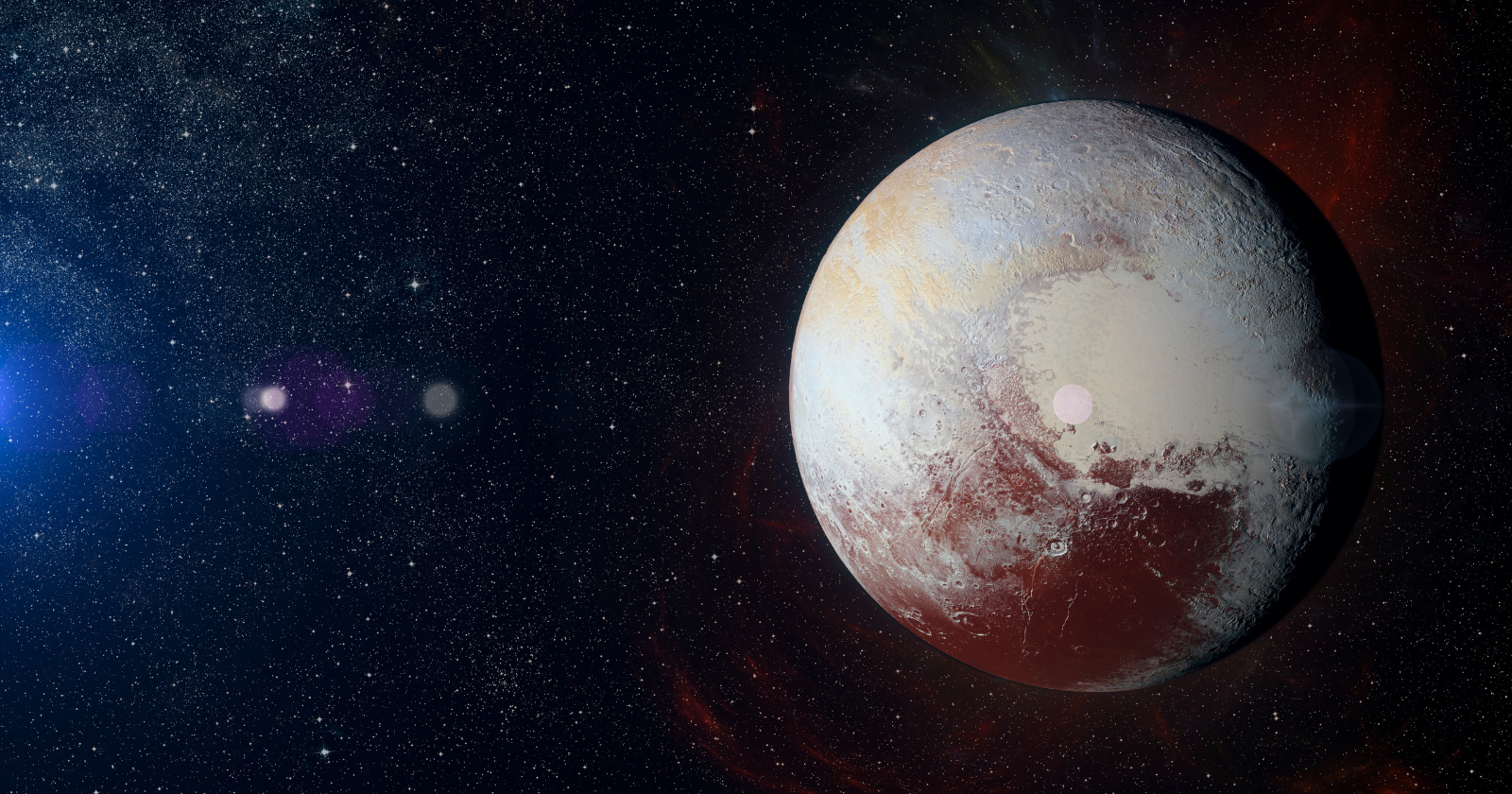
Pluto’s most powerful new advocate is now the head of NASA.
On Tuesday, April 28, NASA Administrator Jared Isaacman testified before the U.S. Senate Committee on Appropriations to discuss the agency’s fiscal 2027 budget request. Most of the hearing covered the usual ground: Artemis II’s recent success, the Nancy Grace Roman Space Telescope launch timeline, and the steep proposed cuts to NASA’s science programs. Then, in the final moments, Republican Senator Jerry Moran of Kansas pivoted to a topic that has become a recurring obsession in Washington’s space-policy circles. He asked Isaacman what he thought of Pluto.
The answer was unambiguous. “I am very much in the camp of make Pluto a planet again,” Isaacman told the committee, according to Space.com. He went further, revealing that NASA is actively preparing a position to push through the scientific community. “We are doing some papers right now on, I think, a position that we would love to escalate through the scientific community to revisit this discussion.”
The Kansas connection
Moran’s question was not random. Pluto was discovered in 1930 by Clyde Tombaugh, a self-taught farm boy from Streator, Illinois, who built his own telescopes from farm equipment and was hired at Lowell Observatory in Flagstaff, Arizona, where he made the find. Tombaugh later spent decades teaching at Kansas State University. Senator Moran has been one of his most consistent posthumous defenders.
Isaacman invoked Tombaugh directly when he answered. He said NASA’s effort would aim to ensure that Tombaugh “gets the credit he received once and rightfully deserves to receive again,” as Scientific American reported. The framing matters. By making the case about Tombaugh rather than abstract taxonomy, Isaacman gave the campaign a human anchor that resonates well beyond planetary science circles.
Not the first time Isaacman has weighed in
Isaacman, a billionaire private astronaut and tech entrepreneur who took over NASA earlier this year, has been hinting at this position for months. In a March interview with the Daily Mail, he told the outlet that he “100% supports President Trump making Pluto great again.” That was the first public signal that the new NASA administration intended to put institutional weight behind the Pluto restoration movement.
He is also not the first NASA chief to take the position. Jim Bridenstine, who led the agency during Trump’s first term, declared in 2019 that “Pluto is a planet, and you can write that the NASA administrator declared Pluto a planet once again.” Bridenstine had no formal authority to redefine planetary classifications either. The point of these declarations, then and now, is to apply pressure to a debate that the International Astronomical Union has steadfastly refused to reopen.
The political backdrop
The “Make Pluto Great Again” movement has acquired surprising political momentum in the past year. In May 2025, Star Trek actor William Shatner posted on X that Elon Musk should “ask the President to sign one of those Executive thingies to make Pluto a planet again.” Musk, then one of Trump’s closest advisers, replied, “I’d support that.” In February 2026, Republican Senator Mike Lee of Utah publicly asked Trump to “make Pluto planetary again,” as Yahoo News documented.
Trump has not yet weighed in publicly on the substance, but his administration’s posture on naming and reclassifying things suggests the door is open. On the day of Isaacman’s swearing-in, Trump issued a sweeping executive order on space policy that committed the U.S. to returning astronauts to the moon by 2028 and beginning a permanent lunar base by 2030. Whether a Pluto reclassification proclamation is on the table remains unclear.
What NASA can and cannot do
The complication is jurisdictional. The IAU is a private international organization of professional astronomers that defines the official terminology for celestial objects. Neither NASA, nor the U.S. president, nor any government has formal authority to overrule its decisions. A presidential executive order declaring Pluto a planet would be legally binding inside the U.S. federal government but would have no standing in the broader scientific community.
What NASA can do is exactly what Isaacman described. The agency can produce papers, fund research, support conferences, and lobby the IAU to revisit its 2006 definition. Several leading planetary scientists have been making essentially this case for years. Alan Stern, principal investigator of the New Horizons mission, has argued for nearly two decades that the IAU’s “cleared its orbit” criterion is logically inconsistent. University of Central Florida planetary scientist Philip Metzger has shown in peer-reviewed work that working planetary scientists do not actually use the IAU definition in published research.
The science is moving in Pluto’s direction
What makes this campaign different from previous flare-ups is that the data has continued to accumulate in ways that strengthen the planet-restoration case. New Horizons’ 2015 flyby revealed Pluto to be a geologically complex world with nitrogen-ice glaciers, mountain ranges of water ice, a layered atmosphere, and a likely subsurface liquid water ocean. Recent studies have identified two probable cryovolcanoes, Wright Mons and Piccard Mons, plus a possible supervolcanic eruption at Kiladze crater within the last few million years.
None of that proves Pluto must be a planet by any particular definition. But it does mean the gap between Pluto’s geological reality and the public’s mental image of “small dead ice ball” is far wider than it was in 2006. Stern and his colleagues have argued for a geophysical planet definition based on whether a body is massive enough to be in hydrostatic equilibrium, which would restore Pluto and add roughly 100 other bodies, including several large moons, to the planet count.
What happens next
Isaacman did not commit to a timeline for the NASA papers, nor did he indicate whether the agency would push for an IAU vote, a presidential proclamation, or both. The IAU’s next general assembly is scheduled for 2027. If NASA wants to escalate the discussion through formal scientific channels, that meeting is the obvious target.
In the meantime, the campaign has already achieved something concrete. The most senior space official in the U.S. government has publicly committed his agency to revisiting Pluto’s status, and that commitment was made on the record before a Senate committee. Whether or not the IAU agrees, the conversation has officially moved out of the planetary science community and into the political mainstream.
Pluto, in other words, is now a federal priority. Clyde Tombaugh would probably approve.