



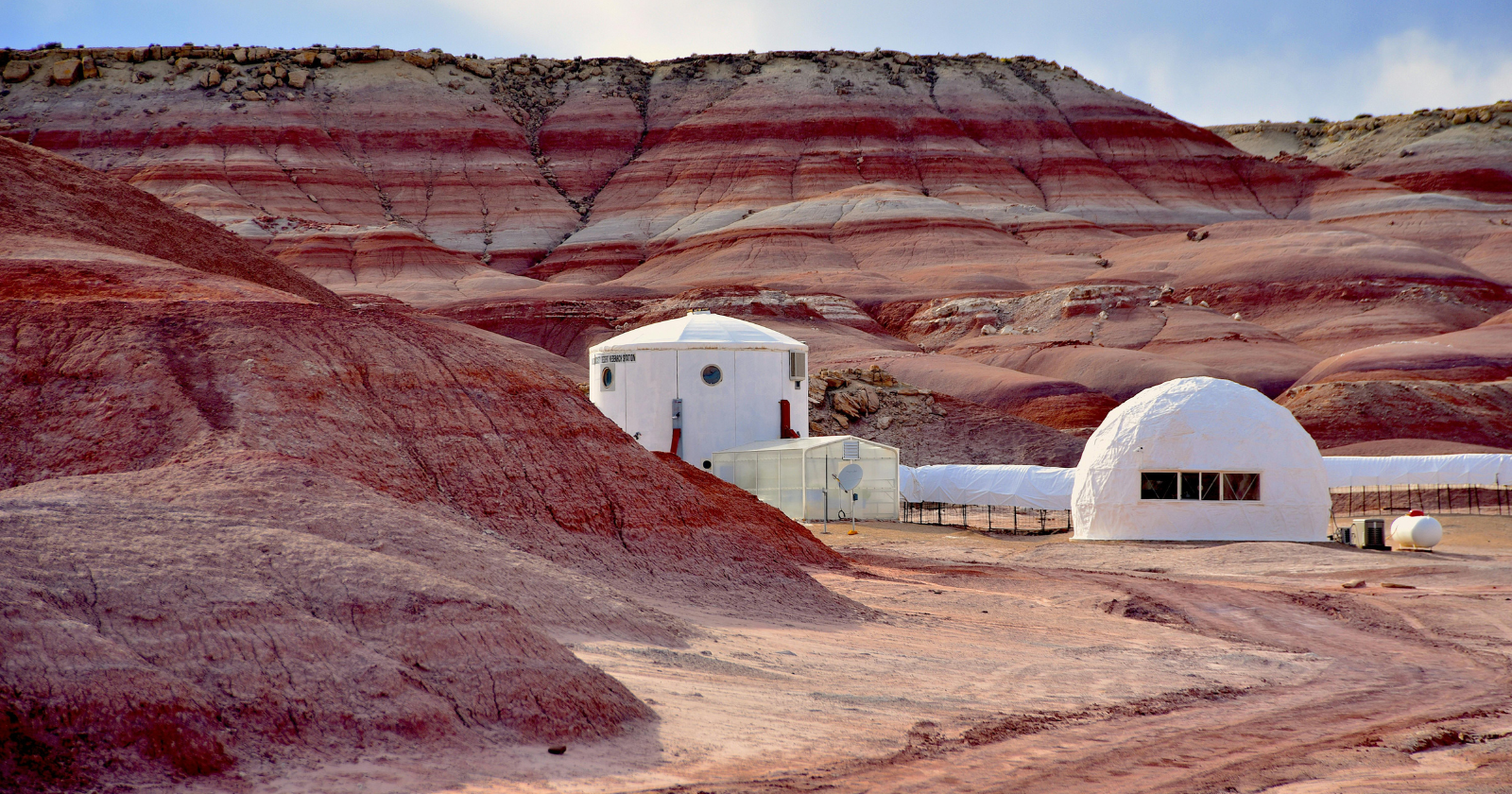
Mars has been the answer for as long as humans have been able to look up at it. Domed cities. Brave settlers tilling the rust-coloured soil. A second chance for our species after we’ve finished wrecking the first one.
The reality is something else. Mars is not a frontier waiting patiently for us. Mars is, by almost every measurable standard, a planet that would actively try to kill anything that landed on it.
I’ve been reading a lot about Martian colonisation lately, partly out of curiosity, partly because my daughter is going to grow up in an era where this is a serious public conversation. The deeper I get into the actual science, the more I’m struck by how much romance falls away when you look at the data.
Here’s what trying to build a home on Mars would actually look like.
The air would kill you
Forget breathing. Mars’s atmosphere is roughly 95% carbon dioxide, with traces of nitrogen and argon. Oxygen makes up less than 0.2%.
It’s also barely there. The atmospheric pressure on the Martian surface is less than 1% of Earth’s. You wouldn’t suffocate so much as come apart.
NASA’s MOXIE experiment on the Perseverance rover has successfully extracted small amounts of oxygen from Martian air, which is genuinely promising. But every breath would have to be manufactured on site, in a sealed habitat, indefinitely.
Then there’s the cold. The average surface temperature on Mars is around -63°C, with winter polar lows reaching -153°C. That’s not “grab a jacket” cold.
The dirt itself wants to poison you
Here’s a fact that surprised me when I first read it. The dust covering Mars contains perchlorate salts at concentrations of around 0.5 to 1%. They’re toxic to humans.
You can’t just track this stuff into your habitat. It would coat suits, equipment, and lungs. Future settlements would need ongoing decontamination protocols just to deal with what gets walked through the airlock.
And the dust gets everywhere. Mars has dust storms that can cover continent sized areas and last for weeks.
You would be unimaginably alone
This is the part I found hardest to sit with as a parent.
Depending on where Earth and Mars are in their orbits, a one-way radio signal between the two planets takes anywhere from about 4 to 24 minutes. So a round-trip exchange can stretch out to nearly 48 minutes.
That means if your daughter asks how your day went, there’s no real-time conversation. Even a quick “I love you” lands almost half an hour after she said it. There is no FaceTime on Mars. There is only delay.
Then there’s distance. The journey to Mars takes around 9 months. There is no rescue mission if something goes wrong. No supply run if the food runs out. You take what you take, and you make what you can. Everyone who has ever loved you is either there in that buried bunker with you, or millions of miles away across the void.
I think about this in my quiet moments. The thing that makes us human is connection. The thing Mars takes away most ruthlessly is connection. That’s not a small detail.
Your body would slowly come undone
Mars has 38% of Earth’s gravity. That sounds light and fun. It’s not.
The human body is engineered for 1g. Bones strengthen against it. Muscles develop against it. The cardiovascular system pumps against it. Take that load away for years on end and the body starts to disassemble itself in slow motion.
Final words
I’m not anti-Mars. The science we’ll learn from going there is staggering. The engineering being attempted is some of the most beautiful problem-solving humans have ever taken on.
But there’s an idea that keeps surfacing for me when I read about all this. The mind always assumes that somewhere else will solve the problems of here. A new house. A new city. A new partner. A new planet. And then we arrive and find we’ve brought ourselves with us, along with most of our problems, into an environment that has far fewer of the things that made us happy in the first place.
We live on a planet with breathable air, drinkable water, edible plants, magnetic protection, and billions of other humans to love. We can ride bikes through cities. We can hold our children outside, under a sky that won’t kill them.
Looking at Mars hasn’t made me want to go. It’s made me want to take much better care of the place I’m already in.