



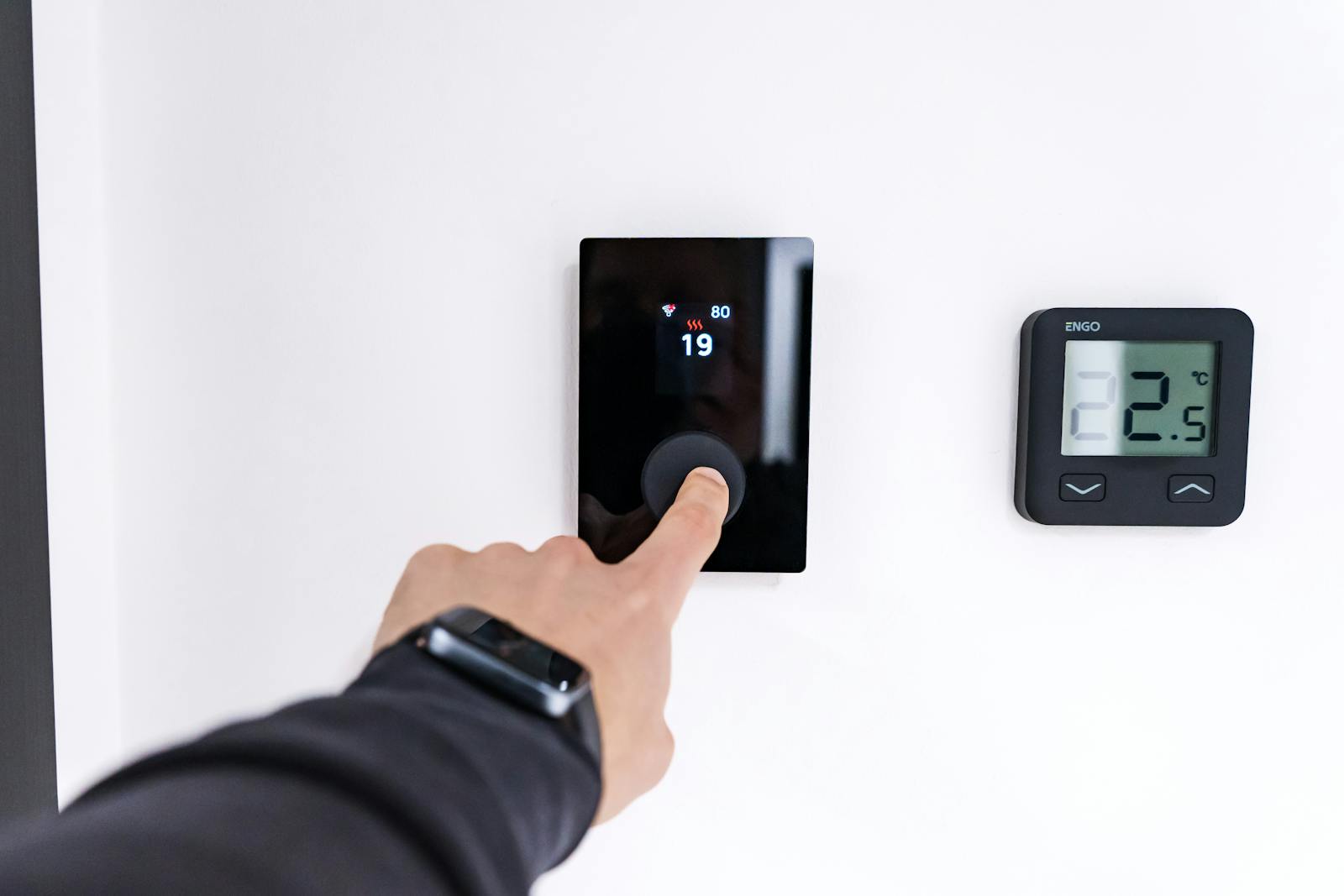
I have come to think of the thermostat as one of the most accurate emotional artifacts in any home. It tells you almost nothing about a person’s current finances. It tells you a great deal about what their nervous system learned when they were eight.
In 1973, the OPEC oil embargo turned thermostats across America into household battlegrounds. Children of that era watched their parents calculate whether to wear two sweaters or pay the bill, and many of those children, now in their fifties and sixties, still keep their homes at 64 degrees while their spouses shiver in protest. The body remembers what the mind has long since filed away as ancient history.
The thermostat is rarely about the thermostat
When someone insists the house stay cold, the partner across the room hears frugality. Or stubbornness. Or a small daily cruelty dressed up as virtue. What is actually happening is older than the marriage, older than the mortgage, older than the relationship itself.
A child who watched a parent flinch at the heating bill — not complain, flinch — absorbed something that reading about money cannot teach. They learned that warmth has a cost, and that the cost has a face, and that the face belonged to the person they loved most in the world.
That kind of learning does not leave. It moves into the body and waits there, quietly, for the next forty years.
What the research actually shows
The temptation, when writing about childhood financial stress, is to declare that growing up poor permanently rewires people. The reality is messier. A 2025 replication study from the Leeds School of Business found that childhood poverty explained less than 1% of variation in adult financial risk-taking, dramatically smaller than a celebrated 2011 study had suggested.
That finding matters, because it pushes back against a deterministic story. People who grew up watching the heating bill arrive are not doomed to anything. Their behavior in adulthood is not the inevitable output of a childhood algorithm.
But the same study found something else worth sitting with. People from lower-income childhood backgrounds did show slightly elevated risk-taking when they felt threatened. The mechanism is not poverty itself. It is the threat response that poverty installed.
Translate that into a household, and you get the thermostat. The bill is not threatening. The body remembers when it was.
What stressed parents pass down without meaning to
Yale psychologist Rajita Sinha and colleagues recently published work in Pediatrics showing that parental stress shapes children’s eating behavior and health outcomes in ways most prevention programs miss entirely. Children whose parents could not regulate their own stress were six times more likely to move into the overweight or obesity risk category over a short follow-up period.
The point is not about food. The point is about transmission. Whatever the parent cannot metabolize, the child will absorb. Stress about money. Stress about safety. Stress about whether there will be enough.
Research examining the interplay of child behavior and parental regulation found a related dynamic: child behavior stress is linked to lower self-regulation in parents, creating a feedback loop that shapes how children learn to manage their own emotional weather.
Children do not learn money from lectures. They learn it from watching the small involuntary movements of their parents’ faces.
The flinch is the lesson
Here is what I find people miss when they describe their parents as frugal or strict about heat. The lesson was almost never delivered as a lesson. There was rarely a speech about energy costs.
There was a flinch when the envelope arrived. There was a long pause before opening it. There was a particular silence at dinner the night the bill came.
The child watching this scene does not consciously file it. They do not think, my parent is afraid of this envelope. They simply learn that some objects in the house contain danger, and that warmth is one of the things that summons them.
Forty years later, that child is an adult standing in their own hallway, adjusting the thermostat down two degrees, and they could not tell you why it feels so important. They only know that turning it up feels like doing something wrong.
Why understanding doesn’t dissolve the pattern
Intellectual knowledge of a psychological pattern does almost nothing to release you from it. People who can articulate exactly why they are like this with money still find themselves, on a Sunday evening in January, unable to leave the heat on overnight without a feeling they cannot quite name. They have read the books. They can explain the mechanism in clinical language. None of that dissolves the tightness in the chest when the thermostat climbs past 68.
The body’s archive is not impressed by your insight.
How partners read each other wrong
The conflict in households over thermostats is rarely resolved by spreadsheets. One partner produces calculations showing that another two degrees would cost twelve dollars a month. The other partner agrees that the math is correct, and then declines to change the temperature.
This looks like irrationality. It is not. It is a person trying to negotiate with a feeling that predates the negotiation by several decades.
What the math-producing partner often misses is that they are not arguing with their spouse. They are arguing with a parent who flinched in 1978. The spouse is just standing where the parent used to stand.
This is the same dynamic that shapes adults raised around chronic emotional reactivity. The behavior outlives the original threat by decades, and the person performing it has long since lost the thread that connects it to its source.
The economic stress model
Family stress researchers have spent years documenting what they call the family stress model — the cascade by which economic pressure on parents translates into emotional and behavioral effects on children. A study published in Frontiers in Psychology tracking Asian American families during COVID-19 found that economic stress reliably predicted disrupted parenting and worse child outcomes.
The model is straightforward. Parents under financial pressure experience emotional distress. Distressed parents struggle to provide warm, consistent caregiving. Children growing up in that environment encode the parents’ anxiety as ambient information about how the world works.
The thermostat is one of the most reliable carriers of that information, because heat in a household is constant, costly, and visible on a monthly bill. There is nowhere to hide it from a watching child.
It is not always poverty
One thing worth saying clearly: the parents who flinched were not always poor. Plenty of middle-class families operated on the edge of financial fear that did not match their bank balance. The parent had grown up poor themselves, or had lived through a period of unemployment, or carried a generational memory of scarcity from their own parents.
Wealth in the present does not erase fear from the past. I have known surgeons and lawyers who refuse to turn the heat up, and the explanation is rarely about money. It is about a feeling that arrived in childhood and never left.
This is part of why the conditions of childhood continue to influence adult behavior long after the original circumstances have changed. The conditions changed. The person who lived through them did not get the memo at a cellular level.
What actually helps
People want a tidy intervention. Recognize the pattern, name it, set the thermostat to 70, feel free. It rarely works that cleanly.
What I have seen work, both in the people I have talked with and in my own life, is something slower. The first move is recognizing that the discomfort with warmth is not a moral position. It is a feeling, and it has a history, and the history is not your fault but it is now your responsibility.
The second move is letting the feeling exist without obeying it. Turning the heat up two degrees and noticing that the old sensation arrives. Sitting with the sensation rather than acting on it. Watching it crest and pass without anything bad happening.
This is the same kind of slow work I described when I wrote recently about how patience accumulates from countless small refusals. Inherited anxiety dissolves the same way. Not in one decision but in hundreds.
What to do if you live with someone like this
If you are the partner of someone who keeps the thermostat lower than feels reasonable, the worst approach is the one most people try first: rational argument. You will not win. You are arguing with a parent the person buried decades ago.
What works better is curiosity. Asking when they remember first noticing the heating bill. Asking what their parents were like about money. Asking it without trying to win, because the moment they sense you are gathering ammunition, the conversation closes.
Most people who keep their homes cold have never been asked these questions. They have been criticized, lectured, and bargained with. They have not been asked, with genuine interest, what the cold is protecting them from.
The Greater Good Science Center at Berkeley has written extensively about how adult children carry their parents’ emotional patterns long after the family system has otherwise dispersed. The patterns do not need active reinforcement to persist. They just need to have been installed early enough.
The wider point
The thermostat is one example. There are dozens of others. People who reuse tea bags. People who wash and reuse aluminum foil. People who get visibly anxious when others leave lights on in empty rooms. People who cannot bring themselves to throw away food that has clearly turned.
Each of these behaviors is sometimes about money in the present. More often, it is about a parent in the past — a parent who taught, without ever meaning to, that resources were not safe to spend.
The point of recognizing this is not to feel sorry for ourselves or to blame our parents, who were almost always doing the best they could with their own inherited fear. The point is to know what we are actually responding to when we make the small decisions that shape our days.
If you keep the thermostat low and you genuinely enjoy a cool house, that is a preference, and there is nothing to examine. If you keep it low and there is a tightness in your chest at the thought of turning it up, that is something else. That is your eight-year-old self still trying to keep your parent from flinching.
You can let them off the hook now. The bill arrived, and it was always going to arrive, and your parent survived it, and so did you. You are not betraying them by being warm. You are not honoring them by being cold. The vigil ended a long time ago, and the small body that kept it deserves, at last, to come inside and thaw.
Photo by HUUM │sauna heaters on Pexels