



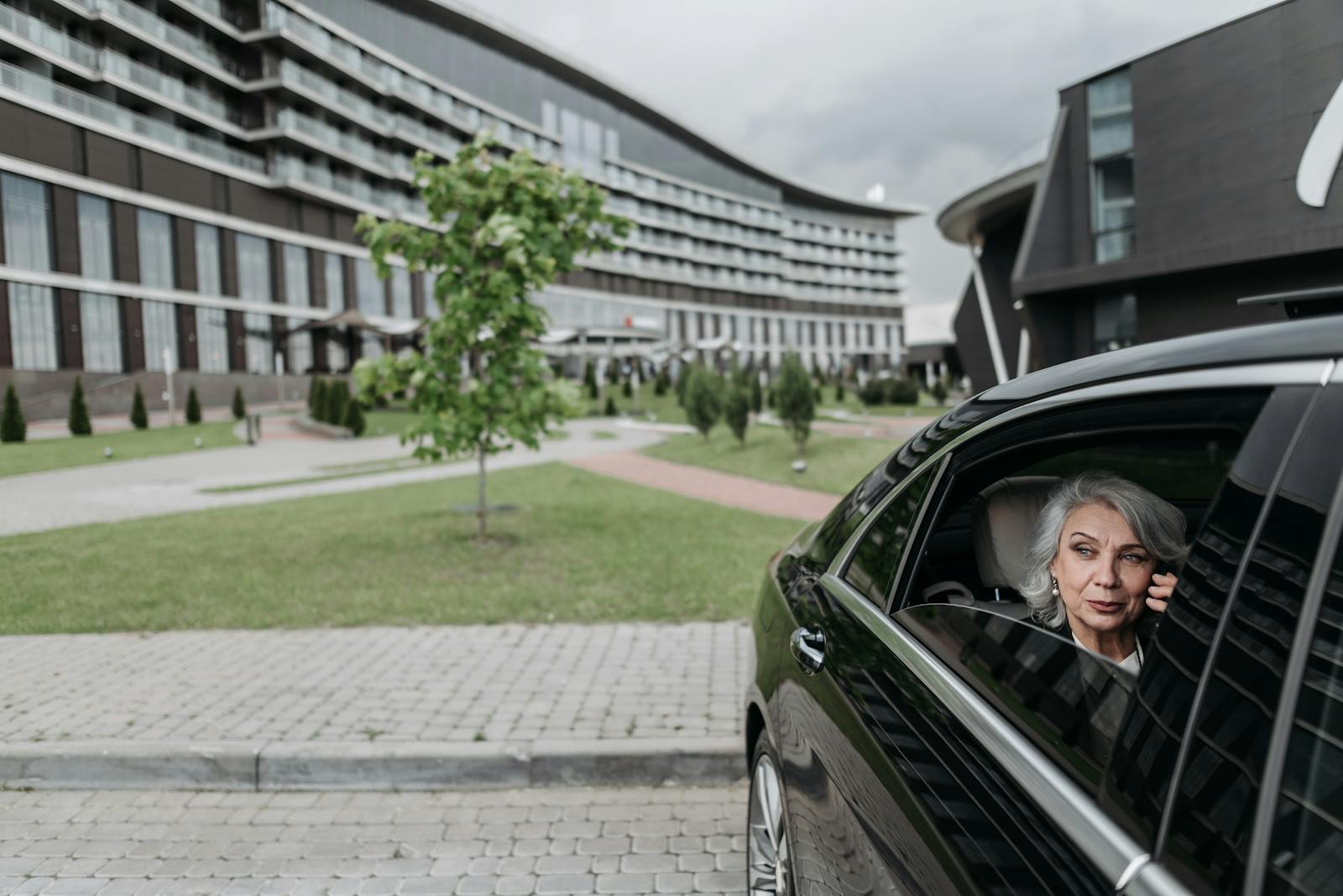
The car in the driveway has become one of the most honest spaces in modern life. It is the last private room before the demands resume, the threshold where adults routinely sit with the engine off, groceries unmelting in the back seat, scrolling nothing in particular, because the distance between the steering wheel and the front door is the only place left where no one is asking them for anything.
This behavior is not a symptom of unhappiness. It is a symptom of load.
The Driveway Decompression
The people who cry in the car before walking inside are usually not in crisis. They are often the most functional members of their households. They are the parents who packed the lunches, the employees who ran the meeting, the adult children who called to check on a parent during the commute. The car becomes the only room in their day that does not contain a request.
That is not a small thing. Emotional regulation requires a place to do the regulating. Without one, the body starts improvising.
Psychologists describe emotional regulation as the ability to notice an emotion, understand it, and choose an intentional response rather than react on impulse. What most people do not talk about is how physically locational this process is. You cannot regulate an emotion you are not allowed to feel. And in a home where three other people need dinner, homework help, and an audience for their day, feeling is a luxury that gets postponed indefinitely.
Why the Car, Specifically
The car works because it fits a very particular psychological brief. It is enclosed, which signals safety to the nervous system. It is soundproofed enough to cry in. It belongs to you. And critically, no one inside the house can see you doing it.
That last part matters more than people realize. Environmental psychology research has found that private spaces designed around restoration and emotional processing have measurable effects on stress recovery. Most homes were not designed with that in mind. Bedrooms get shared, bathrooms get walked into, kitchens become command centers. The car is the one room with a lock that nobody disputes.
It is also mobile. You can park it somewhere unfamiliar. You can sit in it without a reason. You can leave the radio on or off. For a few minutes, the role you play in everyone else’s life is suspended.
The Load Nobody Sees
What tends to precede the driveway cry is not a single hard thing. It is the accumulation of small emotional transactions that never got closed. The colleague who made a passive comment in the morning meeting. The text from your mother you did not have time to answer properly. The child who had a meltdown at drop-off. The email you read but have not replied to. Each one of these left a small residue, and the body stored them because there was no time to process them in the moment.
By 6 p.m., the residue has compounded. The car is where it finally lands.
This is consistent with what neuroscientists observe in the frontal cortex. Patterns of frontal alpha asymmetry, measured by EEG, reflect individual differences in how people approach or withdraw from emotional stimuli. People who spend all day in approach mode — engaging, responding, managing, performing — eventually need a withdrawal phase to rebalance. If the home does not provide one, the car has to.
The Myth of the Relaxing Home
Homes are marketed as refuges. For many adults, they are actually the most demanding room in the building.
The home is where the second shift begins. It is where the kids need you, the partner wants to debrief, the dog has not been walked, and the dishes from breakfast are still in the sink. For caregivers especially, crossing the threshold means stepping back into a role with continuous performance requirements. The commute home was the last gap in the schedule. When that gap ends, so does the last chance to feel something without managing it.
Parents of young children feel this acutely. I think about it on school pickup days with my own seven-year-old. The drive home is short, but it is the only stretch where neither work nor family is actively pulling at me. I have started to notice that the people who seem most composed in public are often the ones who have learned to use those small gaps intentionally, because they know the house will not give it back to them.
What the Crying Actually Does
Crying in the car is not weakness. It is discharge. The body is completing a stress response that was interrupted earlier in the day — possibly many times earlier in the day.
Research on emotion regulation describes this as the difference between suppression and expression. Suppression, the strategy most adults default to at work and in parenting, is metabolically expensive. A recent editorial on emotional regulation and human flourishing notes that chronic suppression without eventual expression correlates with worse long-term well-being. The people who cry in the car are, counterintuitively, doing the healthier thing. They are letting the system reset before they rejoin the people they love.
The alternative is bringing the full weight of the day into the kitchen and taking it out on whoever is closest. Most caregivers have done this at least once and spent the next week feeling guilty about it. The driveway cry is the pressure valve that prevents the next one.
The Connection to Early Conditioning
There is a pattern in who does this most. It tends to be people who grew up in households where their emotions were not welcome.
If crying was criticized when you were six, you learned to do it privately. If anger was punished, you learned to swallow it. If love felt conditional on your performance, you learned that feelings get in the way of being the person people need you to be. Those patterns do not disappear in adulthood. They just get more sophisticated. The car is the grown-up version of crying into your pillow.
This is adjacent to something I wrote about last week — the people who can’t sit still in silence. Both behaviors share a root. When you were not given permission to have an inner life as a child, you either avoid it entirely or you find small, stolen pockets for it. The car is one of those pockets.
Interoception and the Body’s Quiet Signals
Part of what happens in the car is that the body finally gets heard. Psychologists call this interoception — the awareness of internal bodily signals like breath, heart rate, and muscle tension. Research on interoceptive awareness as a skill for emotion regulation explores how people may become disconnected from internal bodily signals during busy workdays. You ignore the tight jaw, the shallow breathing, the full bladder, because responding to them would slow you down.
The moment the engine turns off, those signals catch up. You notice your shoulders are somewhere near your ears. You notice you have not taken a real breath in two hours. You notice you are, in fact, sad, and have been sad all day, but did not have time to be.
The crying is just the body’s way of telling you it has been paying attention even when you were not.
When It Becomes a Warning Sign
A weekly driveway cry is not pathology. It is maintenance. But there is a line.
If the car is the only place you feel like yourself, that is data. It means the rest of your life has become performance, and the performance has no intermission. People in this situation often describe feeling like a stranger in their own home — functional, responsive, present in body, but not actually occupying the experience. This is the territory covered in feeling most alone in rooms full of people who love you. It is possible to be deeply loved and still be depleted, because love and rest are not the same resource.
The warning sign is not the crying. It is the absence of any other place where the crying would be allowed.
Building a Second Room
The long-term fix is not to stop crying in the car. It is to make the car not the only option.
That usually means two things. First, a conversation with the people in the house about what decompression actually requires. Ten minutes of non-negotiable transition time after walking in. A closed door that does not require justification. A walk around the block before dinner. Second, an internal permission that most adults have to grant themselves, because nobody else is going to. Permission to not be useful for a small stretch of the evening.
Classroom researchers studying adolescents have found that students who can recognize and name their own emotional states form stronger relationships with peers and teachers. The adult version is the same. You cannot be genuinely present for the people you love if you never had the minute required to figure out how you are actually doing.
The Bigger Picture
Modern domestic life has compressed. Commutes that used to serve as decompression are now sometimes skipped entirely thanks to remote work, which means the transition from work-self to home-self happens in the thirty seconds between closing a laptop and answering the first question from a child. Public spaces that used to offer solitary rest — libraries, coffee shops, park benches — have become either monetized or crowded. Even public seating design is now studied for its effect on emotional regulation in young people, because the places people used to recover quietly have grown scarce.
The car filled a gap that used to be filled by other things. A porch. A long walk. A commute by train where you could stare out the window. Losing those places did not make the need go away. It just made the car work harder.
What It Really Means
The person crying in the driveway is usually someone who loves their life. They love the people waiting inside. They chose this job, this partner, these kids. Nothing is wrong.
They just need five minutes where the answer to “can you” and “would you mind” and “do you know where” is allowed to be no one asked. The car gives them that. It is not a sign that their life is failing. It is a sign that they are still trying to be good at it.
If you are one of these people, the kindest thing you can do is stop interpreting the driveway cry as a personal failure. It is not. It is a functional response to a design flaw in how modern adulthood is structured. The fix is not to need less time. The fix is to stop feeling guilty about the ten minutes you already take.
And if you live with someone who sits in the car a little too long after pulling in, the most loving thing you can do is not go check on them. Let them have the room. They will come inside when they are ready, and they will be more themselves when they do.
Photo by Pavel Danilyuk on Pexels