



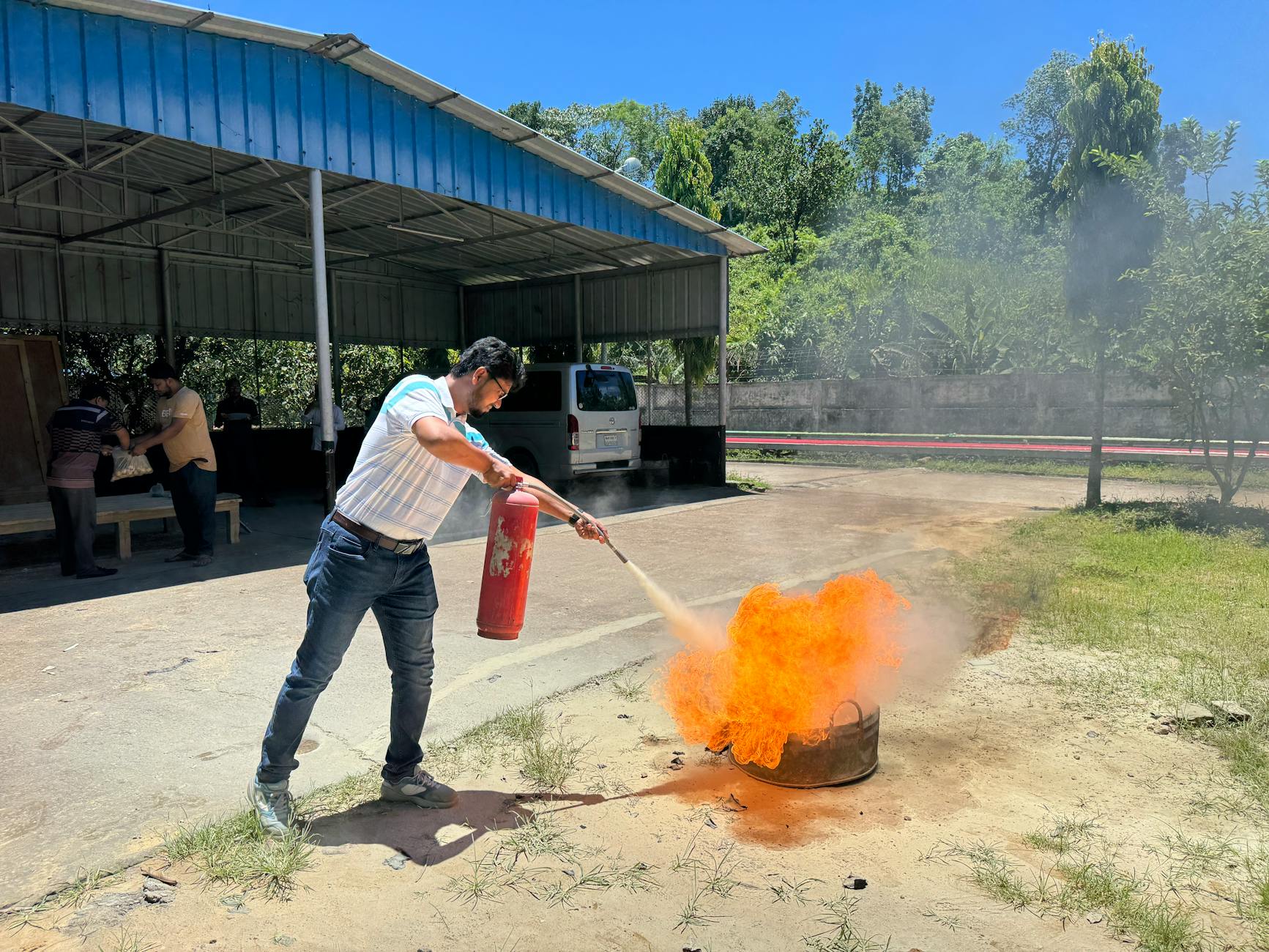
Thomas, a colleague who sat three desks away from me for four years at a newsroom in midtown Manhattan, was the person everyone wanted next to them when the wire lit up with breaking news. When a bombing happened, when a plane went down, when a source on the other end of the line started sobbing into the receiver, Thomas’s face did this thing where it went slightly still, the way water goes still right before it freezes. He’d reach for his notebook. He’d ask the next question in the same tone he used to order lunch. I watched him do this maybe forty times. I assumed, for most of those four years, that he was braver than the rest of us — that some people simply came wired with a larger tolerance for catastrophe. It took me until the final year of working alongside him to understand I had misread him entirely.
Thomas wasn’t calm because disaster didn’t reach him. He was calm because disaster had already reached him, hundreds of times, alone, in the dark, years before it ever showed up at his desk. His composure wasn’t an absence of fear. It was the compound interest of private rehearsal.
Most people believe that the ability to stay functional during an emergency is a personality trait — a fixed quantity of nerve you were either handed at birth or weren’t. That framing is almost entirely wrong, and it does a particular violence to the people who have worked, invisibly and unpaid, to become the person who can dial 911 while everyone else is still processing what they just saw. What looks like bravery from the outside is, for a significant portion of these people, something much closer to recognition. They have seen this before. Not in reality. In their own heads, on loop, at three in the morning, for years.
The quiet architecture of pre-lived fear
There’s a cognitive mechanism underneath this that clinical psychology has been circling for decades. One version of it involves habituation through repeated exposure, and research suggests it forms a central component of many evidence-based trauma and anxiety treatments. The theory, in its cleanest form, is that the nervous system cannot sustain maximum-alarm response to a stimulus it has already encountered many times. Repetition dulls the shock. What was unthinkable becomes merely unpleasant. What was unpleasant becomes procedural.
Some clinicians have argued that this mechanism is doing significant work across many modalities of talk therapy, regardless of what school the therapist trained in. In one useful reframing, the argument has been made that all therapy is essentially exposure therapy — that whether you call it cognitive-behavioral work, psychodynamic excavation, or narrative reframing, what’s actually happening is a patient bringing themselves into repeated contact with material that used to overwhelm them, until the material stops overwhelming them. The room provides the safety. The repetition provides the transformation.
What I want to suggest is that the people who seem preternaturally steady during real emergencies have been running an unofficial, unmonitored version of this protocol on themselves for most of their lives. Nobody prescribed it. Nobody supervised it. They just started doing it, usually as children, usually because something in their early environment made them feel that the worst case was not hypothetical.
Who learns to rehearse, and why
The kids who mentally map the exits of every restaurant before the food arrives are not doing a morbid party trick. They are running a simulation. The adult who lies in bed at two in the morning walking through the precise sequence of what they would do if they heard glass break downstairs is not catastrophizing for sport. They are laying cable. When the actual emergency arrives — and for many of these people, it has already arrived once, which is why the rehearsal started — the cable is already there. The signal travels faster than the panic.
This is closely related to a phenomenon I’ve written about before in a piece on people who seem unshakeable in a crisis, but the mechanism I’m describing here is distinct. That earlier argument was about permission — about what happens when a child learns that their fear will not be attended to, so they simply stop expressing it. This is something different. This is about the active, effortful, often obsessive mental work that certain people do in private, without anyone asking them to, to become the version of themselves who can handle what they’re convinced is coming.

What rehearsal actually looks like
It rarely looks dramatic. It looks like a woman who, every time she gets into a car, runs through where she’d brace her body if they were hit from the left. It looks like a man who has scripted, in full sentences, what he would say to his mother’s doctor if the phone call came. It looks like the nurse who walks to her shift narrating the codes she might run that night. It looks like the journalist who reads every obituary of every colleague who was killed in the field, not out of ghoulishness, but to study the geometry of the moment before.
Security researchers have started to formalize this outside of psychological contexts. There’s an entire field now arguing that effective emergency preparedness requires visualization-based training that puts employees inside the moment before the moment arrives, because abstract protocols collapse under stress while sensory rehearsal holds. The body, it turns out, does not distinguish very sharply between what it has lived through and what it has vividly pre-lived. Both leave tracks.
This is the part that most people get wrong about the steady ones. They assume the steadiness is evidence that the person feels less. What’s actually happening is that the person has already felt it, many times, in the privacy of their own imagination, and the nervous system has filed those rehearsals under known territory. The alarm that fires for everyone else — the stress response, the narrowing of focus, the emotional overwhelm — fires at a lower amplitude, because part of the brain is saying, with a shrug, oh, this.
The cost nobody counts
There is a bill for this, and it comes due. I want to be careful here because I don’t want to romanticize what is, in many cases, a form of constant vigilance that these people did not choose and cannot easily switch off. The rehearsal that makes you useful in the emergency is the same rehearsal that makes you unable to sit through a dinner party without tracking the server’s movements, cataloging the exits, and noticing which guest’s laugh has the brittle edge that suggests something is wrong at home.
You become, over years, a person whose baseline cognitive load is higher than everyone else’s around you, because a portion of your attention is always running the simulation. You look composed. You are composed. You are also exhausted in a specific way that most people can’t see, which connects to the particular exhaustion of constant internal performance. When the actual emergency comes and you handle it beautifully, people thank you. What they don’t know is that you have been handling it, in one form or another, for twenty years.
This is why the calmest person in the room after the crash is often the one who falls apart three months later, in a parking lot, for no visible reason. The delayed emotional processing is not a flaw in the system. It’s a feature. Rehearsal buys you functional performance in the acute moment by deferring the emotional reckoning to later, when it’s safer. The bill always arrives. It just doesn’t arrive when everyone’s watching.
Why this matters for how we build emergency response
There’s a policy layer to this that I think goes under-discussed. When institutions talk about who should respond to mental health and public safety crises, the conversation frequently centers on training hours, protocols, and credentials. What it rarely centers on is the question of who, among potential responders, has done the private work — and whether we can teach that work, or whether it can only be lived into.
Research on who actually performs well during frontline mental health crisis response increasingly suggests that conventional law enforcement training, which emphasizes rapid physical control, may be structurally mismatched to the kind of composure these situations require. Advocacy work examining these systems has argued that communities need responders whose steadiness comes from deep familiarity with the specific terrain of psychiatric emergency — people who have pre-lived the scenarios, often because they have lived through them, and whose calm is a form of earned recognition rather than imposed authority. The most effective responders, in other words, are often the ones who look at the person in crisis and see something their own nervous system has already mapped.
This has implications for how we train. Protocol memorization produces compliance under low stress and collapses under high stress. What produces functional performance under high stress is what the body already knows. You can build some of that in a classroom, with good simulation. You build more of it with repeated real exposure. And — this is the uncomfortable part — a significant portion of it gets built by people who have been rehearsing alone, often since childhood, because their early lives taught them the simulation was not optional.
The recognition, when it comes
What Thomas told me, in the final year we worked together, was that the first time he covered a mass casualty event as a young reporter, he had the strange sensation of déjà vu — not because he’d been there before, but because he had already imagined every element of it, in bed, at thirteen, after his uncle died in a fire. He had rehearsed the smell. He had rehearsed the sound of sirens arriving from multiple directions. He had rehearsed the specific task of asking a stranger, on the worst day of their life, whether they were willing to speak. When the moment came, twenty years later, his first internal response was not fear. It was a thin, cold, unwelcome feeling of there you are.
That is the phenomenology of rehearsed calm. It is not fearlessness. It is not a gift of temperament. It is the long echo of private, unpaid, mostly involuntary work that certain people do because something in them understood, early, that the world was not going to warn them twice. They built the map in the dark. When the lights finally went out, they were the only ones who could still walk.
What I want to offer, to the people who recognize themselves in this, is not gratitude — because you’ve been thanked, probably, and the thanks never quite land. What I want to offer is the explanation. Your composure is not a mystery to be admired. It is a record of how much you have already survived, including the things that only ever happened inside your own head.