

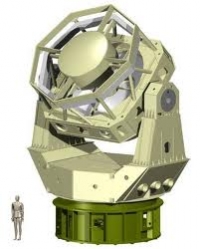
The Space Surveillance Telescope program (SST) is DARPA's ground based, advanced, optical system for detection and tracking of faint objects in space such as asteroids. It is also to be employed for space defense missions. The program is designed to advance, or expand, space situational awareness, and be able to quickly provide wide area search capability.
The large curved focal surface array sensors are considered to be an innovative design. It encompasses improvements in detection sensitivity, has short focal length, wide field of view, and improvements in step-and-settle abilities. SST detects, tracks, and can discern small, obscure objects, in deep space with a "wide field of view system". It is a single telescope with the dual abilities. First the telescope is sensitive enough to allow for detection, also, of small, dimly lit objects (low reflectivity). Second it is capable of quickly searching the visible sky. This combination is a difficult achievement in a single telescope design.
Tags:


Additional Info
- Lead Nation: USA
- Project Website: page on DARPA website
- Project Wikipedia Page: United_States_Space_Surveillance_Network#Space_Surveillance_Telescope_program

Latest from Copernical Team
- Watch Sophie Adenot’s second spacewalk live
- Week in images: 17-21 August 2026
- Sentinel-1 captures major ice loss from Greenland glacier
- Map of Europe's Spaceport
- ESA’s photosynthesis satellite fuelled
- Replay: MTG-I2 pre-launch media briefing
- ESA astronaut Sophie Adenot during EVA-97
- Fly around Schiaparelli Crater with Mars Express
- Hera's Mars flyby guided impact study of Deimos moon
- Sentinel-3 provides faster data for Europe fires


