

NASA selects five US companies to mature Artemis Lander concepts
Wednesday, 15 September 2021 09:23 NASA has selected five U.S. companies to help the agency enable a steady pace of crewed trips to the lunar surface under the agency's Artemis program. These companies will make advancements toward sustainable human landing system concepts, conduct risk-reduction activities, and provide feedback on NASA's requirements to cultivate industry capabilities for crewed lunar landing missions.
The
NASA has selected five U.S. companies to help the agency enable a steady pace of crewed trips to the lunar surface under the agency's Artemis program. These companies will make advancements toward sustainable human landing system concepts, conduct risk-reduction activities, and provide feedback on NASA's requirements to cultivate industry capabilities for crewed lunar landing missions.
The Two Flight Engineers' stay extended in ISS
Wednesday, 15 September 2021 09:23 Two International Space Station crew members have had their stay onboard the orbiting lab extended to nearly a year. Meanwhile, space biology and life support maintenance kept the Expedition 65 crew busy on Tuesday.
With the plans for Russian spaceflight participants to visit the space station as part of the Soyuz MS-19 crew in October 2021, NASA astronaut Mark Vande Hei and Roscosmos cosm
Two International Space Station crew members have had their stay onboard the orbiting lab extended to nearly a year. Meanwhile, space biology and life support maintenance kept the Expedition 65 crew busy on Tuesday.
With the plans for Russian spaceflight participants to visit the space station as part of the Soyuz MS-19 crew in October 2021, NASA astronaut Mark Vande Hei and Roscosmos cosm Dino-killing asteroid set the stage for evolution of modern snakes
Wednesday, 15 September 2021 09:23 For the majority of species living during the Cretaceous period, the asteroid responsible for Mexico's Chicxulub crater spelled doom. But for those that survived, the catastrophe offered opportunity.
According to a new study, published Tuesday in the journal Nature Communications, the asteroid that wiped out the dinosaurs triggered a period of accelerated diversification among snakes. /
For the majority of species living during the Cretaceous period, the asteroid responsible for Mexico's Chicxulub crater spelled doom. But for those that survived, the catastrophe offered opportunity.
According to a new study, published Tuesday in the journal Nature Communications, the asteroid that wiped out the dinosaurs triggered a period of accelerated diversification among snakes. / India to revise FDI policy for space sector, says ISRO chief Sivan
Wednesday, 15 September 2021 09:23 India will soon come out with a new foreign direct investment (FDI) policy for the space sector, Indian Space research Organisation Chairman K. Sivan said on Monday.
In his address at the International Space Conference and Exhibition, organised by Confederation of Indian Industry (CII), on the theme 'Building NewSpace in India', Sivan, who is also Secretary of the Department of Space, said
India will soon come out with a new foreign direct investment (FDI) policy for the space sector, Indian Space research Organisation Chairman K. Sivan said on Monday.
In his address at the International Space Conference and Exhibition, organised by Confederation of Indian Industry (CII), on the theme 'Building NewSpace in India', Sivan, who is also Secretary of the Department of Space, said NASA provides laser for LISA mission
Wednesday, 15 September 2021 09:23 Finding the biggest collisions in the universe takes time, patience, and super steady lasers.
In May, NASA specialists working with industry partners delivered the first prototype laser for the European Space Agency-led Laser Interferometer Space Antenna, or LISA, mission. This unique laser instrument is designed to detect the telltale ripples in gravitational fields caused by the mergers
Finding the biggest collisions in the universe takes time, patience, and super steady lasers.
In May, NASA specialists working with industry partners delivered the first prototype laser for the European Space Agency-led Laser Interferometer Space Antenna, or LISA, mission. This unique laser instrument is designed to detect the telltale ripples in gravitational fields caused by the mergers Russia calls for mechanism to prevent deployment of weapons in space
Wednesday, 15 September 2021 09:23 Russia calls on the international community to start negotiation on the development of a global mechanism banning the deployment of arms in space, Russian Deputy Foreign Minister Sergey Ryabkov said on Monday.
"The most important task on a global scale is to prevent an arms race in outer space. We call for the launch of negotiations on the development of an international, legally binding i
Russia calls on the international community to start negotiation on the development of a global mechanism banning the deployment of arms in space, Russian Deputy Foreign Minister Sergey Ryabkov said on Monday.
"The most important task on a global scale is to prevent an arms race in outer space. We call for the launch of negotiations on the development of an international, legally binding i Northrop Grumman supports test flight for Missile Defense Agency
Wednesday, 15 September 2021 09:23 Northrop Grumman in conjunction with Boeing has completed a critical non-intercept flight test (BTV-03) of the Ground-Based Interceptor (GBI) for the U.S. Missile Defense Agency (MDA). The flight test successfully demonstrated company-developed software that enables upgraded booster capability and enhances America's homeland defense.
"This flight test demonstrated a Northrop Grumman-design
Northrop Grumman in conjunction with Boeing has completed a critical non-intercept flight test (BTV-03) of the Ground-Based Interceptor (GBI) for the U.S. Missile Defense Agency (MDA). The flight test successfully demonstrated company-developed software that enables upgraded booster capability and enhances America's homeland defense.
"This flight test demonstrated a Northrop Grumman-design Laser solid-phase synthesis of single atom catalysts
Wednesday, 15 September 2021 09:23 Laser fabrication of nanoparticles offers a powerful and flexible alternative to the purely chemical approaches. In recent years, laser synthesized precious metal nanoparticles are becoming increasingly important in catalysis due to their unique surface features. In order to minimize the consumption of expensive precious metal-based materials and maximize the utilization of active species in var
 Henry Ford Heads for the High Frontier
Wednesday, 15 September 2021 09:07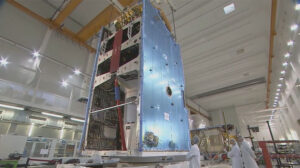
For decades, skilled engineers and technicians have been building satellites designed for unique missions and making them one at a time.
First deep drilling success for ExoMars
Wednesday, 15 September 2021 08:49
ESA’s Rosalind Franklin twin rover on Earth has drilled down and extracted samples 1.7 metres into the ground – much deeper than any other martian rover has ever attempted.
In first, SpaceX to send all-civilian crew into Earth orbit
Wednesday, 15 September 2021 06:57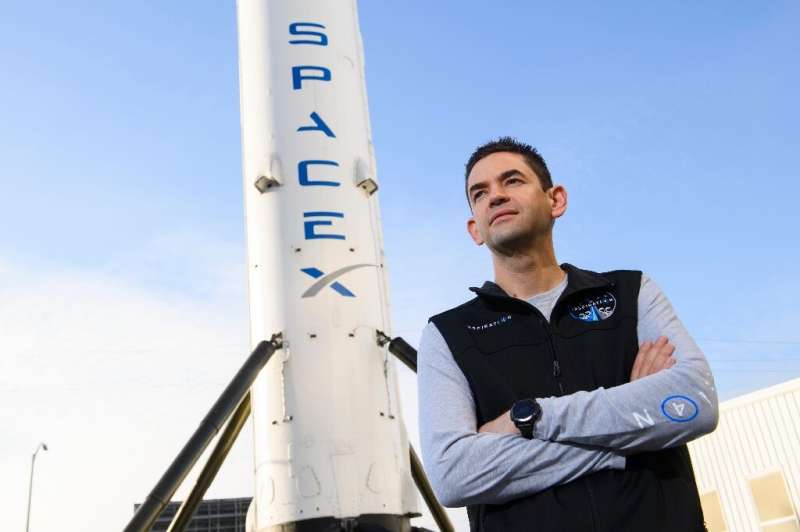
Can four people who've never been to space before spend three days spinning around Earth after only a few months of training?
That's the challenge SpaceX has set for itself when it launches its first tourism mission on Wednesday, the first time a crew of exclusively private citizens will orbit our planet.
A five-hour launch window for "Inspiration4" opens from 8:02 pm (0002 GMT Thursday).
A Falcon 9 rocket, with a Dragon capsule at its top, will blast off from the legendary launch complex 39A at NASA's Kennedy Center in Florida, from where the Apollo 11 mission took off for the Moon.
The spaceship's trajectory will take it to an altitude of 575 kilometers (357 miles), deeper into space than the International Space Station (ISS).
Five key facts on Inspiration4 space mission
Wednesday, 15 September 2021 06:57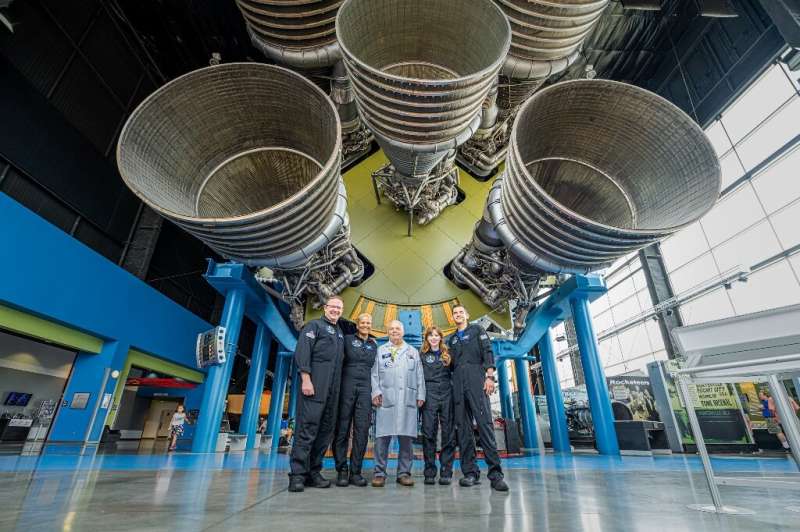
SpaceX is set to launch four people into space Wednesday on a three-day mission that is the first to orbit the Earth with exclusively private citizens on board.
Here are the key facts about Inspiration4.
The spacecraft
At the top of the Falcon 9 rocket, which is 70 meters high, sits the Dragon capsule, where the crew will be.
This spacecraft has already taken 10 astronauts to the International Space Station (ISS) on three separate missions.
The Dragon capsule, eight meters high and four meters wide, has been modified for this flight. A huge glass dome has been installed to offer passengers a 360-degree view of space.
The flight schedule
Take-off is scheduled on Wednesday beginning at 8:02 pm (0002 GMT Thursday) from the NASA Kennedy Space Center in Florida.
OneWeb’s broadband constellation reaching halfway mark
Wednesday, 15 September 2021 00:10
OneWeb is about halfway through deploying its low Earth orbit constellation, after Arianespace successfully launched another 34 satellites for the broadband operator Sept. 14 .
NASA selects five companies for lunar lander studies
Wednesday, 15 September 2021 00:06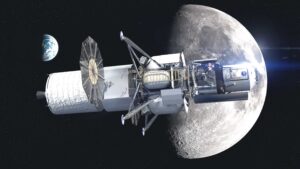
NASA will provide $146 million to five companies, representing the three teams that previously competed to develop the Artemis lunar lander, to perform studies for future lunar lander concepts.
Capella shares SAR data with researchers, app developers
Tuesday, 14 September 2021 22:10
Capella Space announced plans Sept. 14 to share synthetic-aperture radar (SAR) data gathered by its satellite constellation with researchers, nonprofit organizations, application developers and disaster response organizations.