


Samba’s fiery farewell recorded
Tuesday, 01 September 2026 08:05
Yesterday, on 31 August 2026, Samba reentered Earth’s atmosphere at 21:39:38 UTC / 23:39:38 CEST as the third of the four Cluster satellites. Samba had been lined up for a special 'targeted reentry' safely over the South Pacific Ocean, the precision so high that a plane could fly out from Tonga and successfully record its demise for reentry science.
Commercial Space Federation (CSF) Welcomes Two New Associate Members
Monday, 31 August 2026 14:00
August 31, 2026— Washington, D.C.—The Commercial Space Federation (CSF) is pleased to welcome Outlier and Rendezvous Robotics as its newest Associate Members, bringing expertise in reusable satellite platforms and adaptable […]
Media briefing: BepiColombo's next milestone towards Mercury
Monday, 31 August 2026 13:00 Video:
01:09:40
Video:
01:09:40
Rewatch the European Space Agency's 31 August 2026 online press briefing on the latest developments of the ESA/JAXA BepiColombo mission, Europe's and Japan's first mission to Mercury.
This briefing focused on the complexities of the separation of the Mercury Transfer Module (MTM), scheduled for 3 September 2026, a critical milestone marking the start of BepiColombo’s Mercury arrival phase. It also provided an overview of the operational challenges and milestones ahead, including Mercury orbit insertion in November 2026 and the separation of the two science orbiters (ESA's MPO and JAXA's Mio) in December 2026.
The briefing also provided an update
Speed to Field Starts Below the Prime
Monday, 31 August 2026 12:30
I have spent much of my career looking at the defense industrial base from different vantage points: as a warfighter, inside major defense companies, and now leading a company whose […]
What happened this month at the European Space Agency? (August 2026)
Monday, 31 August 2026 12:30 Video:
00:03:19
Video:
00:03:19
August was a busy month for ESA, between spectacular views, historic milestones and exciting new discoveries.
From a total solar eclipse broadcast live from Spain and Sophie Adenot’s historic spacewalks, to the launch of MTG-I2 aboard Ariane 6, a breathtaking flight over Mars and a surprising discovery near our galaxy’s central black hole, here’s your monthly roundup from the European Space Agency.
Nepal flash flood imaged by satellites
Monday, 31 August 2026 10:57
With thousands of emergency responders conducting search-and-rescue operations following the catastrophic flash flood that struck northern Nepal on 26 August, satellite imagery is helping to reveal the scale of the inundation and devastation across the affected region.
Roman lifts off on a mission to survey the infrared sky
Monday, 31 August 2026 06:00 Image:
NASA’s Nancy Grace Roman Space Telescope lifted off on a SpaceX Falcon Heavy rocket from NASA’s Kennedy Space Center in Florida, USA, at 07:26 EDT / 12:26 BST/ 13:26 CEST on 30 August 2026. With the successful launch, Roman began its mission to survey the sky in visible to near-infrared light to help reveal the nature of dark energy and dark matter. The telescope will also investigate the true diversity of exoplanets in our galaxy.
Roman is a NASA-led mission to which the European Space Agency (ESA) contributed star trackers, batteries, and detectors for the coronagraph instrument. ESA will also provide communications
EVA-98: suiting up!
Sunday, 30 August 2026 11:05 Video:
00:01:50
Video:
00:01:50
This timelapse was published by ESA astronaut Sophie Adenot on social media with the following caption:
Day 198 orbit 3070 — Let’s make it three!
A third spacewalk in 15 days is coming up this Tuesday 1 September... This time, it will be an all-woman spacewalk, and I'm looking forward to sharing the adventure with Jessica! (It will be her seventh!)
A huge thank you to the teams once again supporting us throughout this weekend of preparation.
The Sunday Morning Science series will resume very soon, I promise!
– Getting ready for EVA-98 with Anil, with Jessica and
Sophie Adenot's third spacewalk (U.S. Spacewalk 99)
Friday, 28 August 2026 13:00 Video:
00:00:50
Video:
00:00:50
ESA astronaut Sophie Adenot will take part in her third spacewalk during U.S. Spacewalk 99 on Tuesday 1 September. NASA live coverage will begin at 13:00 CEST, with the spacewalk expected to start at approximately 14:30 CEST and last around six and a half hours.
Together with NASA astronaut Jessica Meir, she will replace a retroreflector on the International Space Station’s Harmony module, supporting spacecraft navigation during rendezvous and docking operations. The astronauts will also carry out several maintenance tasks, including installing data-relay system jumper cables, preparing the Alpha Magnetic Spectrometer’s radiator for future maintenance and replacing a
Watch Sophie Adenot’s third spacewalk live
Friday, 28 August 2026 13:00
After two successful spacewalks on 18 August (EVA-97) and 25 August (EVA-98), watch ESA astronaut Sophie Adenot venture into the vacuum of space for the third time on Tuesday 1 September, during EVA-99.
Week in images: 24-28 August 2026
Friday, 28 August 2026 12:10
Week in images: 24-28 August 2026
Discover our week through the lens
 Image:
Fuelling Sentinel-3C
Image:
Fuelling Sentinel-3C Ariane 6 launch with MTG-I2 – highlights
Friday, 28 August 2026 11:20 Video:
00:04:28
Video:
00:04:28
The Meteosat Third Generation-Imager2 (MTG-I2) satellite, has been launched on board an Ariane 6 launcher from Europe’s Spaceport in French Guiana. Liftoff was on 27 August 2026 at 22:11 CEST (17:10 local time).
MTG-I2 is part of the MTG constellation for Eumetsat – two are already in orbit – and it will produce images for weather forecasting in Europe in unprecedented detail. This mission provides completely new data products and capabilities for European weather services, especially suited to nowcasting of severe weather events.
The MTG-Imager satellites carry two instruments, a Lightning Imager and a Flexible
Observing Samba and Tango’s reentries
Friday, 28 August 2026 08:03
The final two of ESA's pioneering Cluster spacecraft, Samba and Tango, will end their journeys as they burn up in our atmosphere on 31 August and 1 September respectively. Their targeted reentries mark the end of a mission that has transformed our understanding of Earth's magnetic environment. The final moments also offer a rare scientific opportunity for reentry observations from a plane.
A navigation odyssey
Friday, 28 August 2026 07:58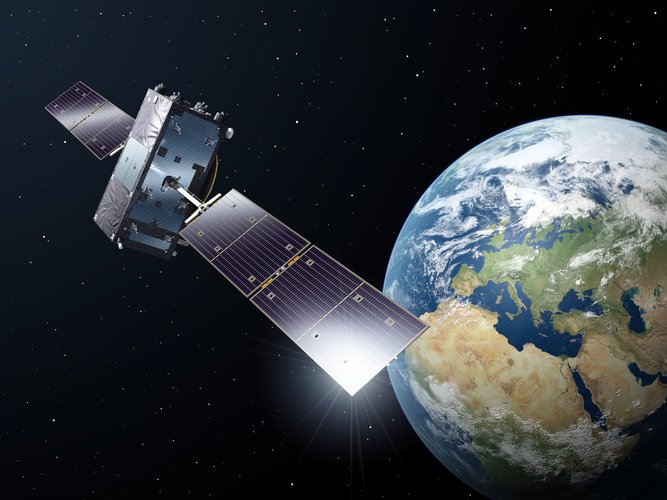
Homer’s The Odyssey chronicles Odysseus’s journey home to Ithaca after the Trojan War. A distance of approximately 530 km as the crow flies, yet it takes Odysseus ten years and countless adventures to arrive—without his crew or his boat. What could Odysseus’s journey have looked like if he had modern-day satellite navigation systems, such as Galileo, at his disposal?