
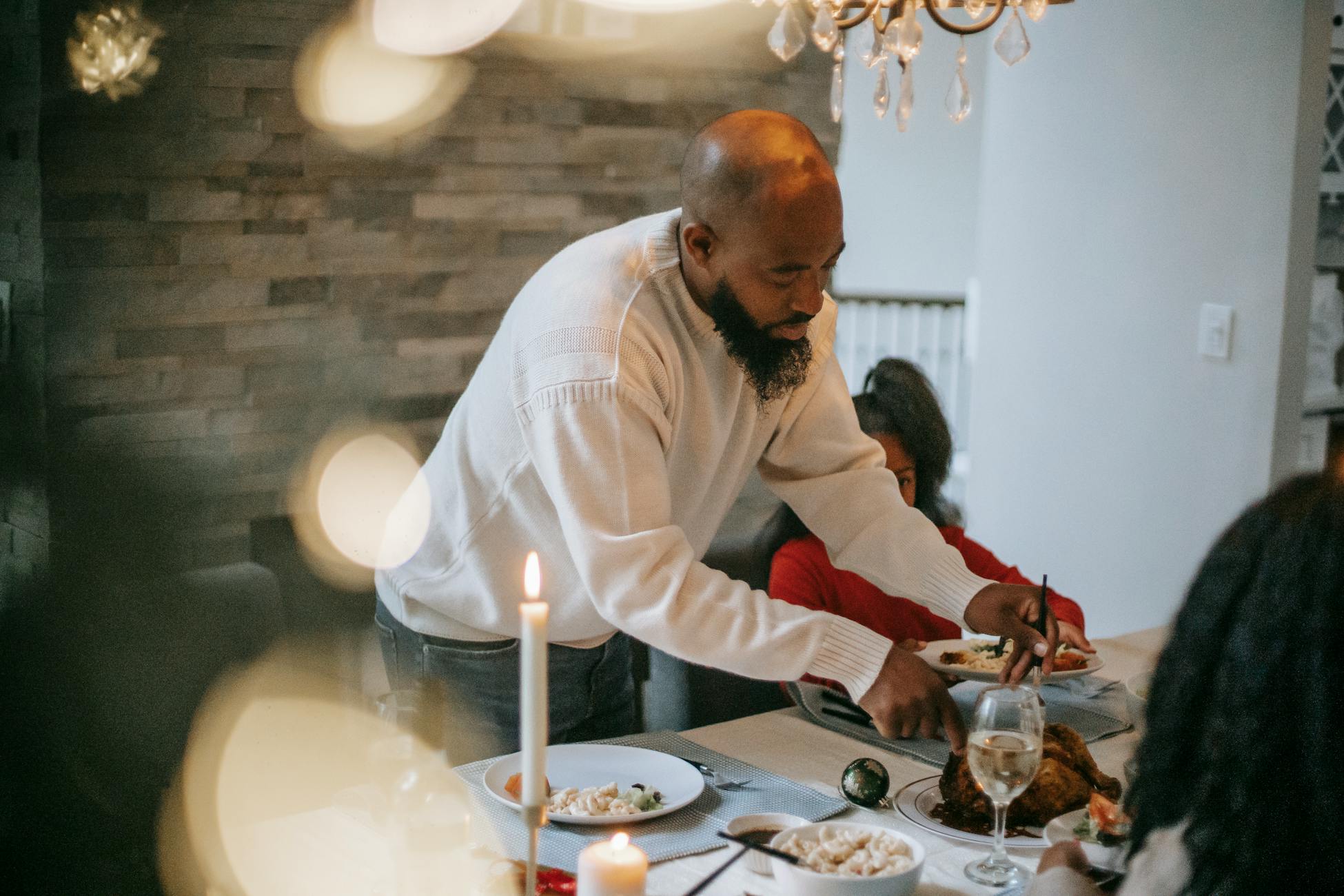
The people who feel most alone at family gatherings are usually the ones who have changed the most since anyone at the table last bothered to update their file. They show up. They hug the right people. They laugh at the right jokes. And somewhere between the appetizer and the main course, a specific kind of exhaustion sets in — the exhaustion of performing a self you no longer live inside.
This is not estrangement. It is not conflict. It is not, despite how it feels, disconnection from the family itself. It is something quieter and more structural: a mismatch between the person who walked through the door and the role that was set at the table for them before they arrived.
Most people assume loneliness at family gatherings comes from poor relationships — cold parents, distant siblings, unresolved fights. That framing is reassuring because it locates the problem in other people, which means the solution is either repair or distance. But the pattern I’ve watched form in capable adults, particularly those who have traveled far from the environments that raised them, is different. The people are fine. The love is real. The loneliness still arrives, right on schedule, somewhere around the second hour of the visit.
What’s happening is role rigidity. Families, like all durable systems, run on compressed models of their members. Your mother holds a version of you that was accurate when you were fourteen. Your uncle holds one from the year you graduated college. Your older cousin holds a version that peaked during a single conversation in 2011. These models are not malicious. They are efficient. A family of eight cannot maintain real-time updates on every member, so it caches. And when you walk into the room, the cached version loads faster than the current one.
The gap between who you are now and who the room expects you to perform is where the loneliness lives. Some therapists working with Internal Family Systems frameworks suggest this as a kind of forced regression — adults reverting, under social pressure, to younger parts of themselves that the family system was originally organized around. The regression is not chosen. It is summoned.
The mechanism is almost always unintentional
Watch closely how it happens and you start to see the choreography. Someone asks a question calibrated to a version of you that hasn’t existed in a decade. You answer in the register they expect, because answering in the register you actually live in would require a twenty-minute preamble about who you’ve become, and nobody at a holiday dinner has the appetite for that. So you shrink. You translate. You hand over a simplified version of your life that fits inside the conversational slot allotted to it.
By the third or fourth exchange, you have spoken entirely in a dialect of yourself you no longer use. The people around you feel close to you. You feel alone in a way that’s hard to explain without sounding ungrateful.
This is not the same as the loneliness of bad families. I’ve written before about the loneliness of households where nobody asked how you actually were, and that’s a different pattern — loneliness encoded in childhood and triggered by environmental similarity. This is something else. This is what happens to the person who did the internal work, left the original environment, built a different life, and now returns to find that the life they built has no seat at the table.
Why the distance feels sharper in capable people
The pattern is most acute in the adults who have changed most dramatically — the first to leave the small town, the first to choose a different career, the first to refuse the religion, the first to marry outside the expected script. The more a person has grown, the more updating the family would need to do to meet them accurately, and the less likely that updating is to happen at scale.
My parents ran a dry cleaning business in Seattle for most of my childhood. The family model of me was built around a specific kid in a specific neighborhood doing specific things — homework at the counter, helping with pickups, navigating two languages between customers and relatives. When I started covering the space industry, the model didn’t update so much as it accommodated. I became known in the family as the one who writes about rockets, a cached description that has survived roughly a decade of actual work. It is not wrong. It is also not remotely sufficient. And when I sit at a family table, I am aware — in a way that feels almost physical — that the version of me being addressed is a shorthand, not a person.
The loneliness is not that they don’t love me. The loneliness is that the person they love is a compression file, and I’ve been operating at full resolution for years.
The research catches up to what the body already knows
Loneliness is one of the most studied emotional states of the last two decades, in part because its health consequences turned out to be more severe than anyone initially predicted. Research summarized by the University of Delaware’s College of Health Sciences describes loneliness as fundamentally distinct from social isolation — you can feel acutely lonely while surrounded by people who know you well. The mechanism is perceived mismatch, not objective distance.
Clinical work published through Psychology Today elaborates on this: loneliness tracks the gap between the connection a person needs and the connection they actually receive, regardless of how many bodies are in the room. A family gathering with twelve relatives can produce more loneliness than a quiet evening alone, because the social expectation of connection raises the baseline against which the mismatch is measured.
The stakes are not psychological alone. A recent prospective cohort study linked self-reported loneliness to elevated risk of degenerative heart valve disease, independent of traditional cardiac risk factors and genetic predisposition. A parallel analysis published in Healio’s cardiology coverage found the same association — and crucially, found it for loneliness but not for objective social isolation. The body distinguishes between being alone and feeling unseen, and it is the latter that appears to wear down tissue over time.
Broader reviews on loneliness and cardiovascular outcomes have reached similar conclusions: the subjective experience of disconnection carries physiological weight that the mere fact of being around other people does not offset. Which means that the person who leaves the family dinner exhausted, slightly depressed, and unable to say exactly why is not overreacting. They are responding to a measurable mismatch.

What gets performed, and what gets buried
The specific thing that gets performed at family gatherings is competence within an obsolete role. You perform the good daughter, the reliable son, the successful one, the funny one, the one who never needed much. These roles were assigned early, they served a purpose in the original family economy, and they calcified into identity slots that the family still routes conversation through.
What gets buried is everything that developed after the role was assigned. The interior life you built in your twenties. The politics you refined. The grief you processed in therapy. The relationship philosophy you hammered out with a partner. The professional identity that now takes up most of your waking hours. None of this has a slot at the table, because the table was set before any of it existed.
This is related to a pattern I’ve explored in the specific loneliness of high capability — the way competence, once established, becomes the thing people see instead of the person underneath. At family gatherings the dynamic inverts but produces the same result: the role, once assigned, becomes the thing people see instead of the person who has been updating underneath it. Either way, the actual human goes unmet.
The misdiagnosis that keeps the pattern alive
Most people who feel this loneliness diagnose it incorrectly. They assume they need to either reconnect more (show up more often, call more, try harder) or distance themselves more (skip the gathering, set the boundary, go no-contact). Neither move addresses the actual problem, which is that the family model of them is out of date and no amount of attendance or absence will update it without explicit intervention.
The capable adult’s instinct is usually to keep performing the cached role, because performing it is efficient, because disrupting it feels ungrateful, and because the family system punishes deviation with subtle social friction — a raised eyebrow, a pointed question, a comment later relayed through a sibling. The cost of updating the model is higher than the cost of absorbing the loneliness, so the loneliness gets absorbed. This is related to what I’ve written about independence as a response to scarcity — the adult who has learned to meet their own needs will almost always choose private discomfort over public disruption.
What the pattern requires, if it’s going to change, is a willingness to be slightly illegible for a while. To answer questions in the register you actually live in, even when it creates awkward silences. To decline the cached role when it’s offered, even when declining feels rude. To let the family update their file on you in small increments, over years, knowing that the update will be incomplete and that some relatives will never make it.
What the loneliness is actually telling you
The loneliness is signal, not failure. It is the accurate response of a fully developed adult to being related to as a simplified version of themselves. The discomfort means the internal self is intact and noticing the gap. People who feel nothing at family gatherings have usually either done the long work of updating the family model or surrendered to the cached role so completely that there’s no friction left.
The friction is where the real self still lives. Which means the loneliness, uncomfortable as it is, is evidence that something worth protecting has survived the years of being compressed at holiday dinners. The work is not to eliminate the loneliness. The work is to stop reading it as a verdict on the family and start reading it as a status report on the self.
You have outgrown the version of you that the room remembers. The loneliness is what outgrowing feels like when the people you love haven’t been able to grow at the same rate. That’s not their fault, and it’s not yours. It is the cost of becoming someone specific enough to have become anyone at all.